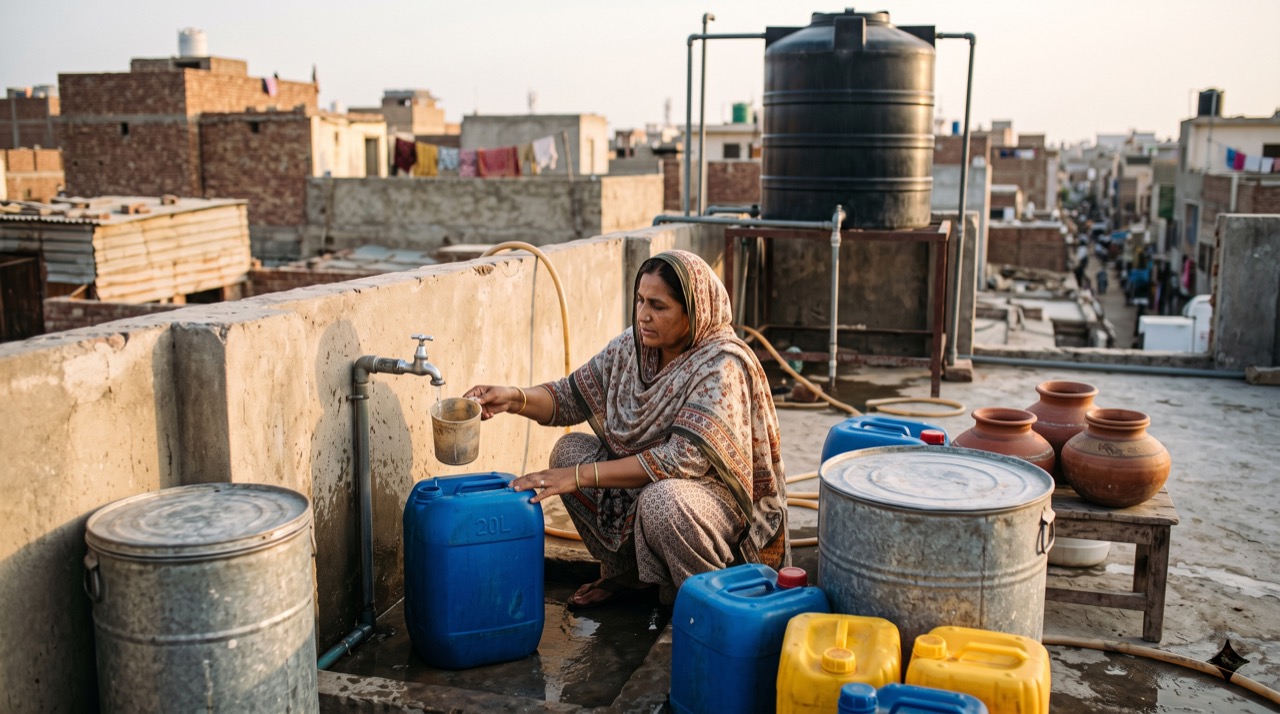
If your home relies on a water tanker, a motor that only runs a few hours a day, or a boring that fills an overhead tank on its own schedule, water storage stops being a small chore and becomes a daily engineering problem. Most Pakistani households already own a tank or two, but very few treat them the way they should — as a food-contact container that needs regular cleaning, correct placement, and a purification step before the water reaches a drinking glass. Bad storage habits are one of the quiet reasons waterborne illness stays common even in homes that never run dry. The good news is that the fixes are cheap and mostly one-time effort. Here is a practical system for storing, rotating, and purifying household water when supply is unpredictable.
Setting Up Your Storage Correctly
The tank itself matters more than people assume. Get these basics right first:
- Use food-grade, opaque tanks. Black or dark-coloured HDPE/PVC tanks block sunlight and slow algae growth. Clear or light tanks left in the sun turn green within weeks.
- Keep the lid sealed and intact. A cracked or loose lid lets in dust, insects, and mosquitoes — a real dengue risk during monsoon months. Replace warped lids rather than propping them shut.
- Elevate underground/ground tanks off bare soil where possible, and make sure the overflow pipe has a mesh guard so it doesn't become an open entry point for pests.
- Separate drinking storage from utility storage. A smaller covered container (even a large clean drum) for drinking and cooking water is easier to clean often than trying to purify an entire 1,000-litre tank every time.
- Check inlet pipes for backflow risk. If your tanker hose or suction pipe ever sits near a drain or sewage line, that is a contamination pathway — keep at least a few feet of separation and never let the fill point touch the ground.
Cleaning and Rotation Schedule
Stored water is not "safe forever" just because it's sealed. Sediment, biofilm, and bacteria build up over time, especially in Pakistan's heat.
- Drain and scrub overhead/underground tanks every 2-3 months. Use a stiff brush, not harsh detergent — plain water plus a diluted chlorine solution (see below) is enough to disinfect the walls.
- First-in, first-out. When a tanker refills a partly-used tank, try to draw down old water before topping up fully, rather than constantly adding fresh water on top of stagnant stock.
- Smaller drinking containers should be washed every 3-4 days and refilled rather than topped up indefinitely.
- After any visible tanker water discolouration, odour, or a gap of many days without refill, treat the whole tank as suspect and disinfect before use, even if it looks clear.
- Inspect twice a year for cracks, rust stains (on metal tanks), or insect entry points — ideally before and after monsoon season.
Purifying Water Before You Drink It
Tanker and motor-drawn water quality varies a lot by area and season, so treat purification as a routine step, not an emergency measure.
- Boiling remains the most reliable method with zero equipment cost: a rolling boil for one full minute kills essentially all bacteria, viruses, and parasites. Let it cool and store in a clean, covered container.
- Chlorination works well for larger volumes. Plain, unscented liquid household bleach (around 5% sodium hypochlorite) at roughly 2-3 drops per litre, stirred and left to stand for 30 minutes, is the standard ratio used in emergency water treatment guidance from bodies like the World Health Organization. Never use scented or colour-safe bleach.
- Household filters (ceramic candle filters, RO units, or UV purifiers) are worth the investment if your budget allows, but their cartridges need regular replacement — a neglected filter can become a bacteria trap worse than no filter at all.
- Water purification tablets are a good backup for travel or short-term gaps in supply and are widely available at pharmacies.
- When in real doubt about tanker source quality, guidance from local authorities such as the Pakistan Council of Research in Water Resources is a useful reference point for what "safe" actually means in terms of testing.
A tank that looks full and clean is not the same as a tank that is safe — the difference is almost always in the habits around it, not the water itself.
Everyday Habits That Make a Real Difference
- Always use a dedicated, clean jug or ladle for drawing drinking water — never dip hands or used glasses directly into a storage container.
- Keep a simple written log of tanker delivery dates and last cleaning date stuck near the tank; it removes the guesswork of "when did we last clean this?"
- Teach children to close container lids fully after use — small gaps are where most contamination starts.
- During load-shedding or motor downtime, store only as much water as you'll use in 2-3 days in secondary containers, rather than hoarding large amounts that then sit too long.
None of this requires expensive equipment — it requires a routine. Once cleaning and rotation become habitual, irregular supply stops being a health risk and becomes just a scheduling inconvenience.
Roman Urdu
Agar aapke ghar mein pani tanker se aata hai ya motor sirf kuch ghante chalti hai, to sirf tank bhar lena kaafi nahi — sahi storage aur safai bhi utni hi zaroori hai. Bahut se ghar tank ko saaf rakhne ki fikar hi nahi karte, jis se pani mein bacteria aur algae ban jaate hain.
Sabse pehle, tank hamesha dark colour (kala ya neela) aur food-grade material ka ho, taake dhoop andar na jaaye aur algae na banay. Lid hamesha tight aur bilkul theek honi chahiye — tooti hui ya dheeli lid se dhool, machhar aur keeray andar chale jaate hain, jo dengue jaisi bimariyon ka risk barha deta hai. Jahan mumkin ho, peene ka pani utility (nahane-dhone) wale pani se alag, chhote saaf container mein rakhein.
Tank ki safai ka ek routine banayein — har 2-3 mahine baad tank khali kar ke brush se ache tarah saaf karein. Jab tanker naya pani laaye, koshish karein purana pani pehle khatam ho jaaye, phir naya bharein — hamesha purane pani ke upar naya pani na daalte rahein. Agar pani ka rang ya smell ajeeb lage, ya kai din tak refill na hua ho, to poora tank disinfect karein chahe pani saaf hi kyun na lag raha ho.
Peene se pehle pani ko purify karna na bhoolein. Ubalna sabse asaan aur bharosemand tareeqa hai — pani ko poora ek minute tez ubalein, phir thanda kar ke saaf bartan mein rakhein. Bade tank ke liye plain, bina khushboo wala bleach (5% sodium hypochlorite) 2-3 boond per litre daal kar 30 minute chhod dein — yeh tareeqa World Health Organization ki guidance mein bhi diya gaya hai. Agar budget ho to RO ya UV filter bhi lagwa sakte hain, lekin cartridge waqt par badalna zaroori hai warna filter khud gandagi ka source ban jaata hai.
Rozana ki chhoti aadatein bhi bohot farq daalti hain — peene ka pani hamesha ek saaf jug se nikalein, haath ya istemal-shuda glass seedha tank mein na dalein. Bachon ko sikhayein ke lid hamesha poori band karein. Aur tanker delivery aur safai ki tareekh kahin likh kar rakh lein, taake yaad rahe ke last cleaning kab hui thi. Ek dafa yeh routine aadat ban jaaye, to irregular supply sirf ek scheduling ka masla reh jaata hai, health risk nahi.