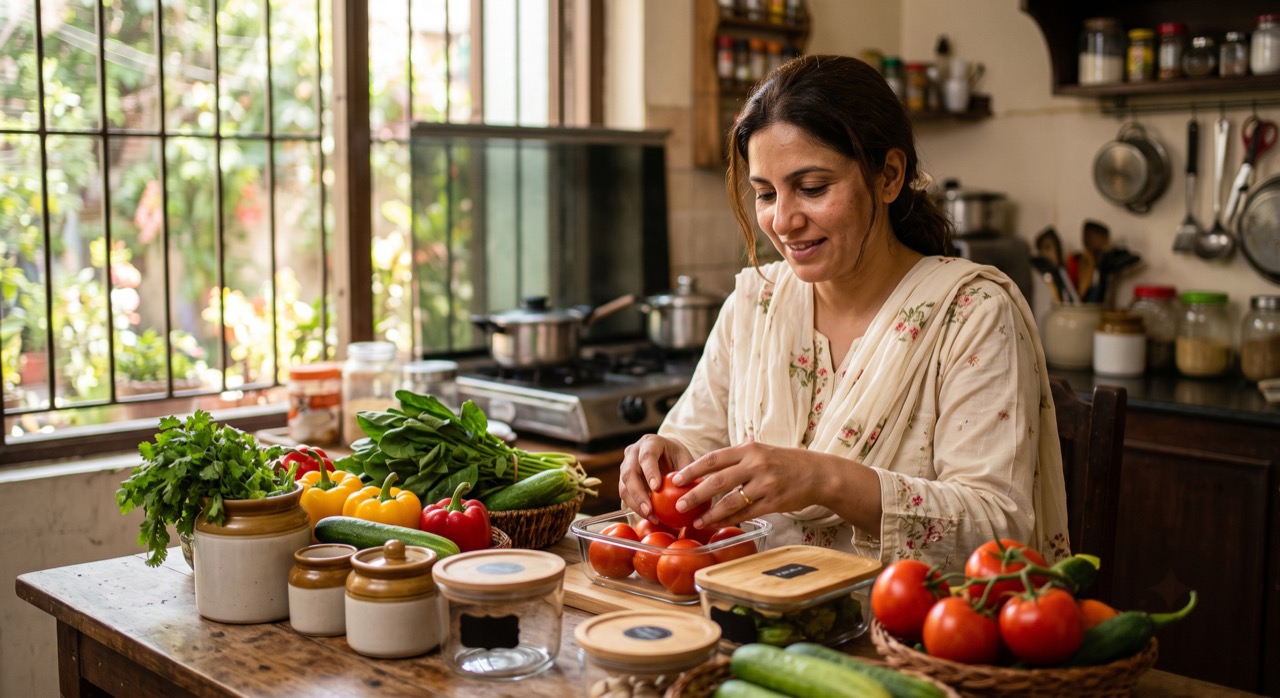
Between May and September, kitchens across Karachi, Lahore, Multan, and Islamabad fight the same losing battle: vegetables bought fresh from the sabzi mandi on Monday look wilted by Wednesday. When outdoor temperatures cross 40°C and even indoor kitchens sit at 30°C+, ethylene gas production speeds up, moisture evaporates faster, and bacteria multiply quicker than in winter. The good news is that most spoilage isn't inevitable — it comes down to a handful of storage habits that take a few extra minutes but save real money every week. Here is a practical, ingredient-specific guide to keeping your sabzi fresh longer this summer.
Prep Before You Refrigerate
Most spoilage starts before the vegetables even reach the fridge, usually because of trapped field heat and surface moisture. A few minutes of prep at the door goes a long way.
- Don't wash before storing: Wash only what you'll cook immediately. Extra surface moisture on stored vegetables speeds up rot and mould, especially on leafy greens like palak and dhania.
- Cool them down first: If you bought vegetables from an open-air mandi in the afternoon heat, let them sit in a shaded, cool spot for 20–30 minutes before putting them straight into a cold fridge. A sudden temperature shock can damage cell walls in tender vegetables like tomatoes and bhindi.
- Trim the tops: For carrots, radish (mooli), and turnips, cut off the leafy green tops before storing. The leaves keep drawing moisture and nutrients from the root, making it go limp faster.
- Pat dry leafy greens: If you must rinse dhania, podina, or palak early, spin or pat them completely dry before storing — even slightly damp leaves rot within a day in summer humidity.
Fridge Storage: Zone by Vegetable Type
Not everything belongs in the same drawer. Grouping vegetables correctly prevents cross-spoilage, since some release ethylene gas that ages others faster.
- Crisper drawer, loosely wrapped: Carrots, mooli, shimla mirch (capsicum), and gobi (cauliflower) keep best in a perforated plastic bag or loosely wrapped in a cotton cloth — this balances humidity without trapping condensation.
- Paper towel trick for greens: Wrap dhania, podina, and palak in a slightly damp paper towel, then place in an open or loosely tied plastic bag. This keeps humidity around the leaves without waterlogging them, often extending freshness from 2 days to 5–7.
- Keep onions, garlic, and potatoes out of the fridge: These do better in a cool, dark, dry pantry or a jute/cloth bag with airflow. Fridge moisture makes potatoes sprout faster and onions turn soft.
- Tomatoes are borderline: Ripe tomatoes can go in the fridge for 3–4 days in peak heat, but they lose flavour and texture faster than at room temperature. If you're using them within a day or two, keep them on the counter away from direct sun.
- Separate ethylene producers: Tomatoes, and any fruit like bananas or mangoes stored nearby, release ethylene gas that speeds up spoilage in leafy greens and bhindi. Keep them in separate drawers or containers.
Pantry and Counter Storage Without a Fridge
Many households, especially with frequent loadshedding, need non-fridge options too.
- Clay pots and matkas: A traditional earthen pot with a damp cloth cover keeps onions, potatoes, and root vegetables noticeably cooler than open room air through evaporative cooling — a low-cost technique worth reviving.
- Keep away from stove heat and direct sunlight: Store pantry vegetables in the coolest, darkest corner of the kitchen, never near the stove or a sunlit windowsill.
- Elevate off the floor: Use a wire basket or shelf rather than a plastic bag directly on the floor — better airflow prevents trapped heat and moisture buildup underneath.
Smart Shopping and Rotation Habits
- Buy in smaller, more frequent batches: In summer, buying sabzi for 2–3 days rather than a full week reduces the amount that spoils before use.
- First in, first out: Place older vegetables at the front of the fridge or pantry so they get used before newer purchases.
- Freeze what you won't use in time: Chopped spinach, peas, and even blanched bhindi freeze well in airtight bags for up to 2–3 months — useful for days when the market run doesn't happen.
A little prep at the kitchen door — cooling, drying, and sorting vegetables correctly — does more to fight summer spoilage than any amount of fridge space.
None of these habits require special equipment or extra spending; they mostly involve five extra minutes when you get home from the mandi. Over a full summer, that small routine can mean noticeably less waste and more rupees staying in your pocket instead of the bin.
Roman Urdu
Pakistan ki garmi mein sabzi jaldi kharab hone ki sabse bari wajah yeh hai ke usay fridge mein rakhne se pehle sahi tareeqay se prepare nahi kiya jata. Garmi mein temperature zyada hone ki wajah se sabzi ki nami jaldi ur jati hai aur bacteria bhi tezi se barhtay hain, is liye chand aadatein apna kar aap sabzi ko kaafi din tak fresh rakh saktay hain.
Sabse pehle, jo sabzi turant use nahi karni usay dhoein mat — sirf woh dhoein jo aaj hi pakani hai, kyun ke extra nami se sabzi jaldi galti hai. Mandi se lai hui sabzi ko seedha thandy fridge mein na rakhein, pehle 20-30 minute tak chawdar jaga par rakhein taake temperature ka jhatka na lagay. Gajar aur mooli ke upar wale patte kaat dein warna woh jar se nami khenchte rehte hain. Dhania aur podina ko thoda gila paper towel mein lapet kar plastic bag mein rakhein — isse woh 2 din ki bajaye 5-7 din tak fresh reh saktay hain. Pyaz, lehsan, aur aloo ko fridge mein mat rakhein, inhein thandi, sookhi aur andheri jaga par rakhein — fridge ki nami se aloo jaldi ankurit ho jate hain. Tamatar aur doosre phal jaise kela ya aam, jo ethylene gas chorte hain, unhein sabzi se alag rakhein warna sabzi jaldi murjha jati hai. Agar fridge available nahi hai to purana tareeqa — matka ya mitti ka bartan gile kapde se dhak kar — bhi kaafi asar dikhata hai. Hafte bhar ki sabzi ek sath khareedne ke bajaye 2-3 din ke liye khareedein taake wastage kam ho. Jo sabzi foran use nahi honi, usay freeze kar lein — palak aur matar freeze karne se mahinon tak chal jate hain. Chand minute ki mehnat se aap apni sabzi ka zyada hissa bachaa saktay hain aur ghar ka budget bhi behtar rehta hai.