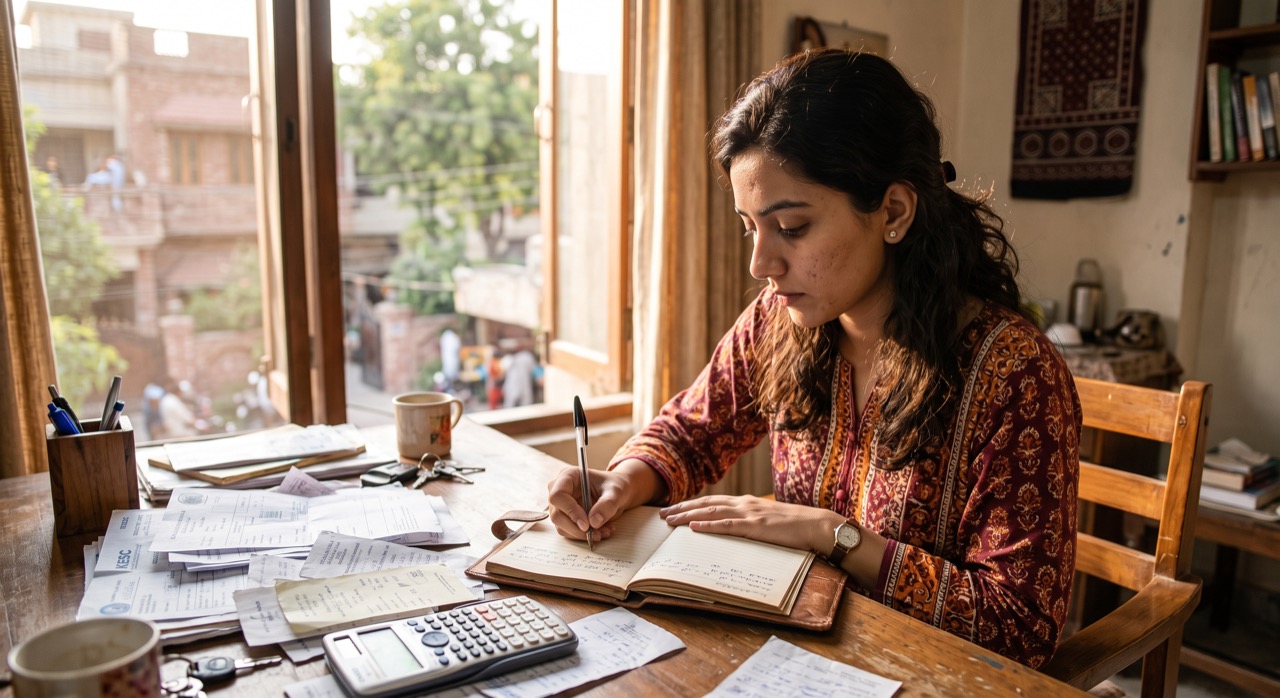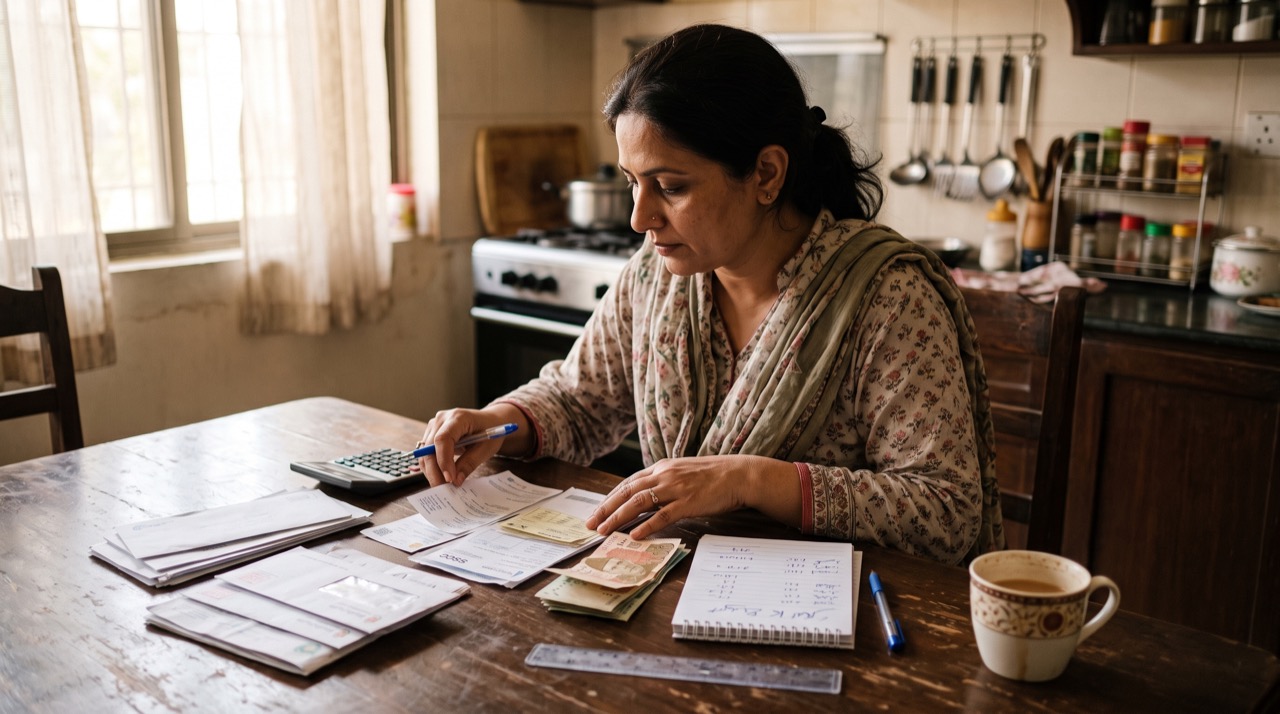
Most household budgets fail not because the family lacks discipline, but because the budget itself is too complicated to keep up. A spreadsheet with forty categories gets abandoned by the second week. The budgets that actually survive are the boring, simple ones: one page, one list of income, one list of expenses, updated in five minutes a day. Here is a template built for real Pakistani households, whether income comes from a single salary, a small shop, or a mix of both.
Start With One Page and Two Columns
Whether you use a notebook, a wall calendar, or the Notes app on your phone, the structure is identical: income on one side, expenses on the other, and a running total at the bottom. Do not overthink the tool. A Rs. 50 notebook from the local stationery shop works exactly as well as an app, and for many families it is easier to see and harder to lose track of than a phone screen.
- Column 1 — Income: salary date and amount, any side income (tuition, tailoring, freelance work), and money coming in from a committee (BC) payout if this is your month.
- Column 2 — Fixed expenses: rent, utility bills, school fees, loan or installment payments, committee contribution.
- Column 3 — Variable expenses: groceries (ration), transport/fuel, mobile load, medical, and a small "extra" line for the unexpected.
Write the month's total income at the very top, in large numbers. This single figure is your ceiling — nothing you plan below it should add up to more than that number.
Group Expenses Into Five Buckets, Not Fifty
The reason detailed budgets collapse is category fatigue — nobody wants to log "Rs. 40 on dhania" separately from "Rs. 60 on tamatar." Instead, use five broad buckets that cover almost every rupee a household spends:
- Ghar (Housing): rent or installment, maintenance, electricity, gas, water, internet.
- Ration & Khana (Food): monthly grocery run plus daily kitchen top-ups.
- Aana-Jaana (Transport): fuel, rickshaw/Careem fare, vehicle maintenance.
- Taleem & Sehat (Education & Health): school fees, tuition, medicines, doctor visits.
- Bachat & Zaroorat (Savings & Miscellaneous): committee contribution, savings, clothes, gifts, emergencies.
A common and workable rough split for a middle-income household is roughly 30% housing, 25-30% food, 10% transport, 15% education and health, and whatever remains toward savings. Adjust these percentages to your actual city and family size — Karachi rent eats a bigger share than a smaller city, for example — but keep five buckets, not fifty.
The 24-Hour Rule for Anything Outside the Plan
Every family has non-essential spending — a new kurta, a phone accessory, eating out. Rather than banning these, give them their own small line item inside "Bachat & Zaroorat" and follow one rule: if an unplanned purchase is not urgent, wait 24 hours before buying it. This alone prevents most of the impulse spending that quietly wrecks a month's numbers, without making anyone feel deprived.
A budget is not a punishment — it is simply deciding in advance where your money goes, instead of wondering afterward where it went.
Review Weekly, Not Just at Month-End
Waiting until the 30th to check your numbers means you only find the problem after it has already happened. Instead:
- Every Sunday evening, spend five minutes comparing what you have spent so far against the monthly plan.
- If groceries are already 80% spent by the third week, cut the transport or miscellaneous bucket to compensate rather than borrowing.
- At month-end, write down one line: what worked, what went over, and one change for next month. Over three or four months this single habit teaches you your family's real spending pattern better than any app.
If you prefer a digital version, Pakistan's mobile wallets and banking apps such as JazzCash and Easypaisa show transaction history that can be reviewed weekly alongside your notebook — useful for catching small digital payments that are easy to forget on paper. The tool matters far less than the habit of looking at the numbers every single week.
Roman Urdu
Ghar ka budget aksar is liye fail hota hai kyunke wo shuru se hi bohat mushkil bana diya jata hai. Jo budget chalta hai wo simple hota hai — ek page, ek taraf income, dusri taraf expenses, aur roz ka thora sa hisaab. Isi liye sab se pehla kaam yeh hai ke aik notebook ya phone ki Notes app mein sirf do column banayein: Income aur Expenses. Mahine ki total income sab se upar bare number mein likhein — yehi aapki limit hai, is se zyada kahin bhi kharch nahi hona chahiye.
Expenses ko pachaas alag categories mein nahi, sirf paanch buckets mein taqseem karein: Ghar (rent, bijli, gas, internet), Ration & Khana (grocery aur roz ka khana), Aana-Jaana (petrol, rickshaw, gari ka kharcha), Taleem & Sehat (school fees, tuition, dawai), aur Bachat & Zaroorat (committee, savings, kapre, emergency). Ek mota andaza: 30% ghar par, 25-30% khane par, 10% aana-jaana par, 15% taleem aur sehat par, aur jo bache wo bachat mein — lekin apne shehar aur family size ke hisaab se yeh adjust karein.
Jo cheez plan mein nahi thi aur achanak khareedni hai — us ke liye 24 ghante ka rule istemal karein: agar zaroori nahi to ek din intezar karein, phir faisla karein. Is se fizool kharchi khud hi kam ho jati hai, bina khud ko mehroom mehsoos kiye.
Budget koi saza nahi hai — yeh sirf pehle se tay karna hai ke paisa kahan jayega, is se pehle ke baad mein pata chale ke kahan chala gaya.
Mahine ke aakhir tak intezar na karein — har Itwar shaam ko paanch minute nikal kar dekhein ke ab tak kitna kharch ho chuka hai. Agar ration ka budget teesre hafte mein hi 80% khatam ho gaya hai, to aana-jaana ya misc. bucket se kaat kar adjust karein, udhaar lene ke bajaye. Digital record ke liye JazzCash ya Easypaisa ki transaction history bhi hafta-warana check kar sakte hain — lekin asal cheez hai har hafte numbers ko dekhne ki aadat, chahe tool koi bhi ho.