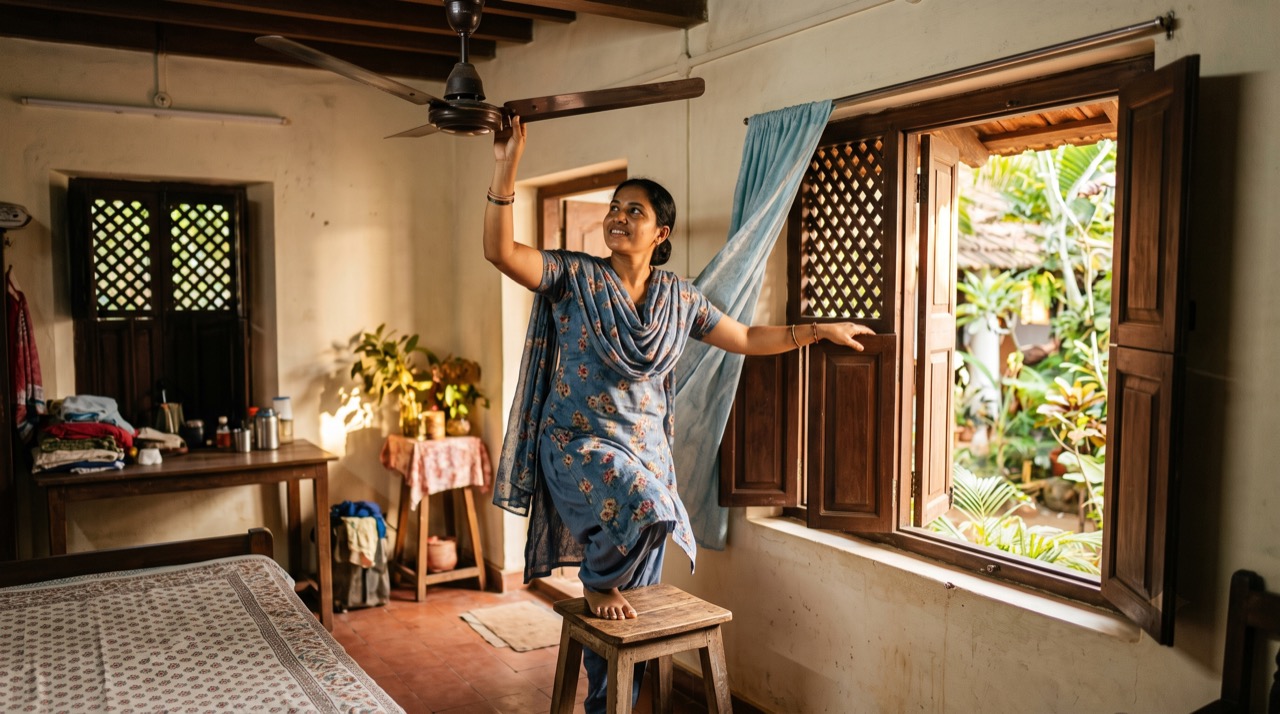
Between load-shedding, rising fuel-adjustment charges, and months of 40°C-plus afternoons, keeping a Pakistani home comfortable in summer without running the AC around the clock feels like a full-time job. The good news is that most heat gain in a typical home comes from just three things: sunlight through windows, trapped hot air with nowhere to go, and fans that aren't doing their job properly. Fix those three and you can drop the felt temperature of a room by several degrees before you ever touch the thermostat.
Block the Heat Before It Enters
Once sunlight hits your glass or bare walls, the heat is already inside — the real trick is stopping it before it gets that far.
- Use thick or lined curtains on east and west-facing windows. Morning and evening sun is low in the sky and hits these windows directly. A medium-to-dark, tightly woven curtain (or a cheap thermal-lined one from any cloth market) blocks far more heat than a thin dupatta-style curtain.
- Close curtains before the sun hits, not after. Shut west-facing curtains by late morning, not at 4 pm when the room is already an oven.
- Add an outdoor layer if you can. A simple bamboo chick (chilman) or reed blind hung outside the window glass stops heat before it even reaches the glass — this is more effective than any indoor curtain alone, since it stops radiant heat from being absorbed by the glass in the first place.
- Light colours reflect, dark colours absorb. If you're repainting an exterior wall or roof, white or light pastel shades reflect a noticeable amount of solar heat compared to dark colours.
- Wet jute or khas (vetiver) screens on windows are an old but genuinely effective trick — the water evaporating through the fibres cools the air passing through, especially useful in drier cities like Multan or Lahore.
Master Cross-Ventilation
Cross-ventilation means air enters from one side of the house and exits from another, carrying heat out with it. Without a clear path through the house, hot air just sits and recirculates.
- Open windows on opposite sides of the house (or diagonally opposite rooms), not just one window in one room. Air needs an entry and an exit point to actually move.
- Ventilate in the cooler hours — early morning before 8 am and after sunset — and keep windows and curtains shut during the peak heat of 12 pm to 5 pm to keep hot outside air from pushing in.
- Keep internal doors open during ventilation hours so air can flow through the whole house rather than getting stuck in a single passage.
- Use a rooftop or stairwell vent if you have one. Hot air rises, so an open vent at the highest point of the house pulls warm air up and out, drawing cooler air in through the lower windows — a passive version of a chimney effect.
Fan Placement That Actually Works
A fan doesn't cool air — it cools people, by moving air across skin so sweat evaporates faster. Placement changes how well that works.
- Position a fan to blow air across you, not just spin overhead uselessly. Ceiling fans should run counter-clockwise in summer (check the switch on the fan body) to push air straight down.
- Use the "exhaust window" trick: point a table or pedestal fan facing out of a window during the evening to actively pull hot indoor air outside, rather than just stirring it around.
- Place a shallow tray of ice or cold water in front of a pedestal fan. The airflow picks up the cool, slightly humid air off the ice and carries it into the room — a low-cost version of an evaporative cooler for one room.
- Don't overcrowd a fan's airflow path. Furniture or curtains directly in front of a fan block circulation; keep at least a few feet of clear space.
A ceiling fan uses roughly the same electricity as a few energy-saver bulbs, while a split AC can use 15-20 times more — running fans smartly first, and the AC only when truly needed, is the single biggest lever on a summer electricity bill.
More Low-Cost Cooling Hacks
- Switch off unnecessary lights and unplug chargers/appliances — incandescent bulbs and electronics generate real heat, and standby power adds up on the bill even when devices are "off."
- Cook during cooler hours or use an outdoor stove/BBQ setup when possible; a running stove and oven can raise kitchen and nearby room temperatures noticeably.
- Set the AC (if used) to 26°C instead of 18°C. Each degree lower can add 6-8% more electricity use, and 24-26°C combined with a ceiling fan feels just as comfortable as a much colder setting alone.
- Damp bedsheets or a wet towel hung near an open window cool incoming air through evaporation — useful during load-shedding hours when fans and AC are both off.
- Check the Pakistan Meteorological Department's heat advisories during peak summer so you can plan errands and ventilation around expected heatwave days: pmd.gov.pk.
None of these tricks require an electrician or a big purchase — just a change in habits around when you open windows, where you place a fan, and how you manage sunlight through the day. Combined, they can meaningfully cut how often the AC needs to run at all.
Roman Urdu
Pakistan ki garmi mein bijli ka bill kam rakhna mushkil lagta hai, lekin ghar thanda rakhne ke liye AC hi sirf hal nahi. Zyada tar garmi teen wajah se ghar mein aati hai: dhoop seedha windows se, hawa ka flow na hona, aur fan ka sahi jagah na hona. In teeno ko theek kar lein to room kaafi thanda mehsoos hoga.
- Moti ya lined curtains lagayein east aur west wali windows par, kyunki subah-shaam ki dhoop seedha inhi se aati hai. Bahar chilman ya bamboo blind lagana curtain se bhi zyada asar dikhata hai kyunki heat glass tak pohanchne se pehle hi ruk jati hai.
- Cross-ventilation banayein — ghar ke do opposite sides ki windows kholein taake hawa ek taraf se aaye aur dusri taraf se nikle. Subah 8 baje se pehle aur maghrib ke baad windows kholein, dopehar ke waqt (12 se 5 baje tak) band rakhein.
- Fan ko sahi jagah rakhein. Ceiling fan garmi mein counter-clockwise chalayein taake hawa seedha neeche aaye. Shaam ko ek table fan window ki taraf mod dein taake garam hawa bahar nikle. Fan ke saamne barf ya thande pani ka tray rakhne se bhi kaafi thandak milti hai.
- Fazool lights aur chargers band rakhein, kyunki yeh bhi heat aur bijli dono barhate hain. AC ka temperature 18 ki jagah 26 degree par set karein — fan ke saath yeh utna hi thanda lagta hai lekin bill kaafi kam ata hai.
- Gili chadar ya tolia window ke paas latkayein — pani ki evaporation se aane wali hawa thandi ho jati hai, khaas kar load-shedding ke waqt jab fan-AC dono band hon.
- Garmi ki lehar (heatwave) ki advisory ke liye pmd.gov.pk check karte rahein taake bahar ke kaam aur ghar ki ventilation us hisaab se plan ho sake.
In sab tips mein koi bara kharcha nahi — bas curtains, windows aur fan ka thora sa smart istemal, aur AC ki zaroorat khud kam ho jayegi.