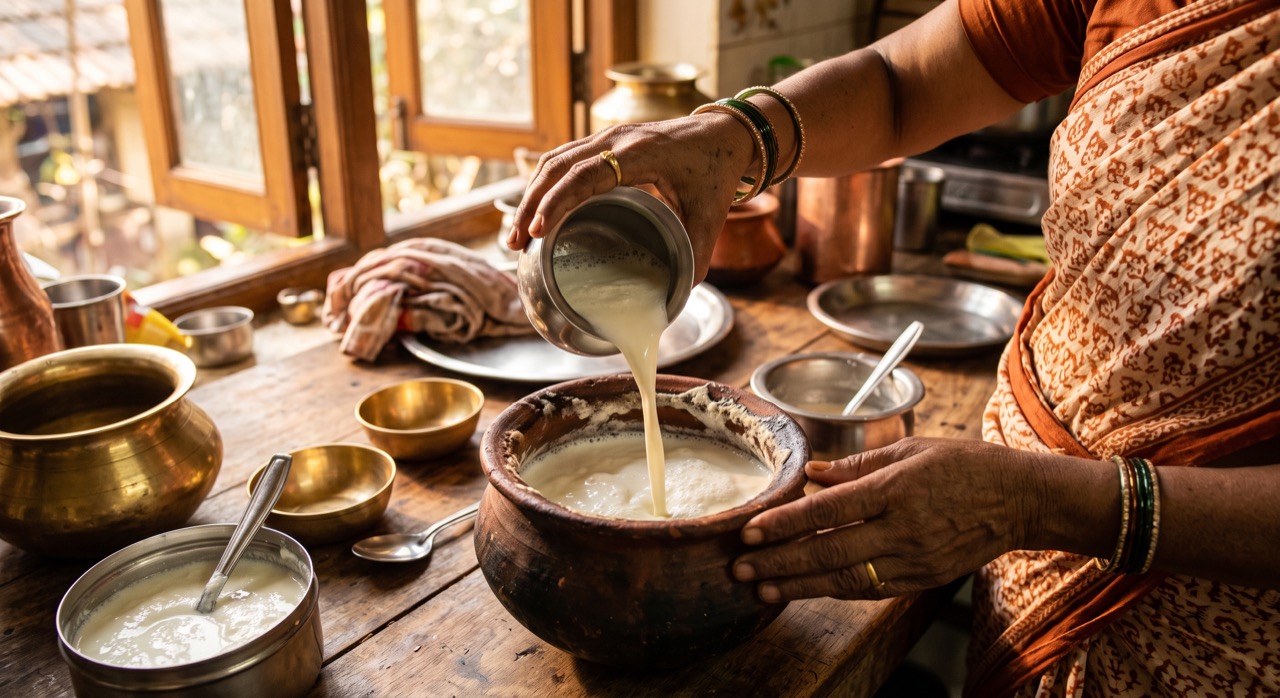
Every household in Pakistan has an aunty who makes dahi so thick you could stand a spoon in it — and every household also has that one batch that turns out watery, sour, or full of holes. The difference almost never comes down to luck. It comes down to three controllable variables: how hot the milk is when you add the starter, how much starter you use and how it's mixed in, and where the pot sits while it sets. Get these right and you can make restaurant-quality dahi at home with nothing more than milk, a spoonful of old dahi, and a warm corner of your kitchen.
Getting the Milk Right
Thick dahi starts long before you add any culture — it starts with how you handle the milk itself.
- Boil it properly. Bring milk to a full boil and let it simmer gently for 5-8 minutes. This concentrates the milk solids slightly through evaporation and denatures the proteins so they set into a firmer gel instead of a loose curd.
- Use full-cream or buffalo milk if you can get it. Higher fat and protein content is the single biggest factor in thickness. If you only have low-fat packet milk, add 2-3 tablespoons of milk powder while boiling to boost solids.
- Cool to the right temperature — this is the step people rush. The milk needs to be lukewarm, around 40-45°C (comfortably warm to the touch, like a baby's bathwater — you should be able to hold your finger in it for a few seconds without discomfort). Too hot and you kill the bacteria in your starter; too cool and fermentation drags on for hours, giving watery, weak-set dahi.
- Skip the ice-bath shortcuts. Cooling too fast in a fridge or cold water bath can cause uneven temperature pockets. Let it cool naturally at room temperature, checking with a clean finger or a kitchen thermometer if you have one.
Choosing and Using the Starter (Jaman)
The starter culture — called jaman or khameer in most Pakistani homes — is what actually turns milk into dahi, and how you use it matters as much as the milk prep.
- Use fresh, active starter. A spoonful of dahi from your last good batch is ideal. If you're starting from scratch, a small amount of plain, unsweetened store-bought yogurt with live cultures works fine.
- Don't overdo the quantity. For 1 litre of milk, 1-2 teaspoons of starter is enough. More starter does not mean faster or thicker setting — it often makes the dahi more sour and can actually produce a looser set because the culture ferments too quickly and unevenly.
- Temper the starter first. Mix your starter with a few tablespoons of the lukewarm milk in a separate bowl until smooth, then stir this mixture back into the rest of the milk. Adding cold starter directly to a full pot creates cold spots that set unevenly.
- Stir gently, then stop. Mix just enough to distribute the culture evenly. Excess stirring afterward breaks the forming protein structure and is a common cause of thin dahi.
- Cover immediately with a lid or plate to hold in warmth and keep dust and odours out.
Finding the Right Setting Spot
This is the step most people get wrong in winter and in air-conditioned homes — the bacteria need sustained warmth, not a quick blast of heat.
- Aim for 40-45°C for 4-8 hours, depending on ambient temperature. In Karachi or Lahore summers, room temperature alone may be enough. In cooler weather or Islamabad winters, you'll need an insulated spot.
- Wrap the pot in a towel or shawl and place it inside a closed microwave, oven (switched off, maybe with the oven light on for gentle warmth), or a cupboard away from drafts.
- Avoid the fridge, windowsills, or near a fan — any temperature swing slows or stalls fermentation.
- Don't disturb the pot while it sets. Movement and repeated lid-checking release heat and can break the delicate curd structure as it firms up.
- Check at the 4-hour mark, then every hour after. It's set when it holds its shape and doesn't wobble like liquid when you tilt the pot slightly. Once set, refrigerate promptly — leaving it out longer than needed makes it more sour and can start separating whey.
Thick dahi isn't a trick — it's just milk that was boiled properly, a starter used in the right amount at the right temperature, and a pot left completely undisturbed in a warm, steady spot.
Troubleshooting Common Problems
- Watery or runny dahi: milk was too hot or too cool when the starter went in, or too much starter was used.
- Sour taste even when fresh: left setting too long, or the room was too warm.
- Grainy texture: milk wasn't stirred while boiling, or it scorched at the bottom of the pot — use a heavy-bottomed pot and stir occasionally.
- Whey separating on top: completely normal once refrigerated a day or two — just stir it back in or drain it off for a thicker, Greek-style dahi.
Roman Urdu
Ghar par thick aur creamy dahi jamane ka raaz sirf teen cheezon mein hai: doodh ka temperature, starter (jaman) ki sahi maqdaar, aur jamane ki jagah ka theek intekhab.
Doodh Taiyar Karna
Doodh ko achi tarah ubalein — 5 se 8 minute tak halki aanch par, taake solids thoda zyada ho jayein aur dahi mota banay. Full-cream ya bhains ka doodh behtar result deta hai. Agar packet ka low-fat doodh hai to ubalte waqt 2-3 chamach milk powder dal dein. Doodh ko naturally thanda karke lukewarm (jaise hath se chhoo kar mehsoos ho lekin garam na lage) tak lay aayein — bohat garam doodh bacteria ko mar deta hai, aur zyada thanda doodh jamne mein bohat waqt le ga aur dahi patla banega.
Starter Ka Sahi Istemal
1 litre doodh ke liye sirf 1-2 chamach purana dahi kaafi hai — zyada dahi dalne se jaldi ya mota nahi jamta, balke khatta aur patla ho sakta hai. Starter ko thoda lukewarm doodh mein pehle mila kar phir poore doodh mein dalein, taake temperature ek jaisa rahe. Halka sa mix karein aur phir bilkul na hilayein — zyada hilana dahi ki structure kharab kar deta hai. Turant dhak dein taake garmi bahar na jaye.
Jamane Ki Jagah
Dahi ko 40-45°C temperature par 4 se 8 ghante tak garam jagah rakhein — jaise band microwave, oven (band, light on kar dein) ya cupboard jahan hawa na lage. Bar bar check na karein, hilayein bhi nahi — bas 4 ghante baad dekhein ke jam gaya hai ya nahi (thoda pot hilane par agar hilta nahi to ready hai). Jamte hi fridge mein rakh dein, warna zyada khatta ho jayega.
Achi dahi ka raaz koi jadu nahi — sahi temperature, sahi maqdaar ka jaman, aur sabar se garam jagah par bina hilaye jamana hai.
Agar dahi patla nikle to samjhein doodh ka temperature ya starter ki maqdaar theek nahi thi. Agar bohat khatta ho to jamane ka waqt kam karein. In choti choti baaton ka khayal rakhein aur har baar perfect, malai jaisi dahi banegi.