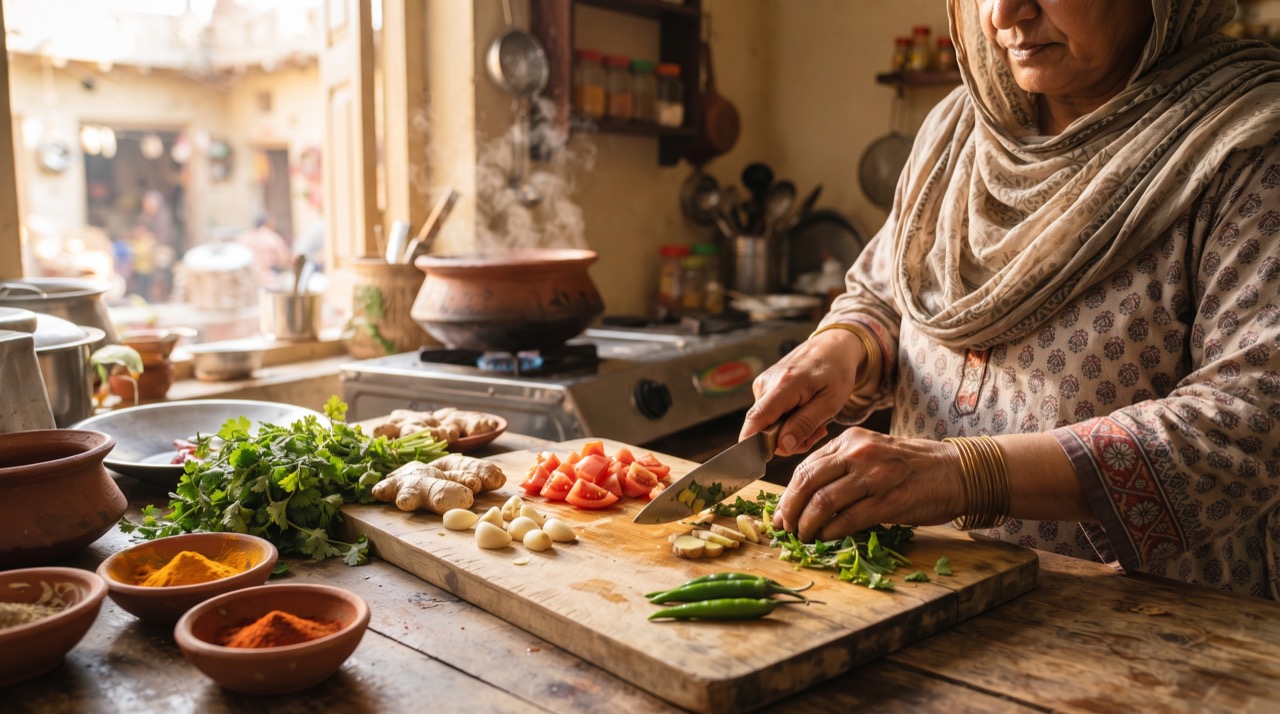
Ask any Pakistani home cook why their karahi or biryani tastes so good, and oil is usually part of the honest answer. It carries flavour, helps spices bloom, and gives that glossy finish we associate with a "proper" restaurant-style dish. The problem isn't desi food itself — it's the quantity of oil and the way we cook it, day after day, that quietly adds up. The good news is that you don't have to choose between taste and health. A few targeted swaps in oil quantity, oil type, and cooking method can cut a meaningful amount of fat from your weekly meals while keeping the dishes recognisably, deliciously desi.
Rethink the Oil, Not Just the Amount
Most home recipes for karahi, qeema, or nihari call for oil "as needed," which in practice often means a generous half-cup or more per dish. You rarely need that much to build flavour.
- Measure it. Use a tablespoon to portion oil instead of pouring straight from the bottle. Most karahi and salan recipes cook perfectly well in 3-4 tablespoons for a family-sized batch, not a full cup.
- Save the "oil separates on top" trick for special occasions. That shiny layer of oil floating on nihari or karahi looks impressive, but it's not what makes the dish taste good — the masala and slow cooking do that work. Cut the oil and you'll barely notice a difference in taste.
- Switch between oils based on the dish. A light mustard or canola oil works well for everyday sabzi and dal, while a small amount of desi ghee added at the end of a dish (not throughout cooking) gives a rich aroma using far less fat than cooking in ghee the whole way through.
- Skim visible oil before serving. If oil rises to the top of a curry, spoon a couple of tablespoons off before plating. It's a habit that costs nothing and removes calories you were never going to taste anyway.
Lighter Biryani Without Losing the Layers
Biryani's flavour comes mainly from the masala, fried onions, and slow dum cooking — not from the oil pooling at the bottom of the pot.
- Fry your onions (birista) in a single large batch using minimal oil spread thin in a wide pan, then drain them well on a strainer or paper towel before adding to the pot. Well-drained birista still gives the same sweet crunch.
- Marinate meat in yogurt, ginger-garlic, and spices for at least a couple of hours — the acidity and spice penetration reduce how much oil you need for the masala base to taste rich.
- Layer the rice and meat with a light drizzle of oil or ghee on top rather than mixing large amounts through every layer. Steam (dum) does the work of marrying flavours, not extra fat.
Karahi and Curries: Build Flavour With Technique
A good karahi depends on high heat, well-browned tomatoes, and properly bhunoed (fried-down) masala — all of which you can achieve with less oil if you're patient.
- Let tomatoes cook down fully until the oil naturally starts to separate from a small quantity, rather than adding more oil to "help" the process along.
- Use a heavy-bottomed pan or a well-seasoned wok so food doesn't stick, which reduces the temptation to add oil out of habit.
- Add a splash of water instead of oil if the masala starts sticking during bhunai — it keeps things moving without adding fat.
Fried Snacks: Bake, Air-Fry, or Shallow-Fry
Pakoras, samosas, and cutlets don't have to disappear from your table — they just need a lighter cooking method now and then.
- An air fryer gives samosas and cutlets a crisp shell using a fraction of the oil of deep frying — brush lightly with oil before cooking for best colour.
- Bake pakora batter as small spoonfuls on an oiled tray at high heat for a lighter version of the classic.
- If deep frying for a special occasion, keep the oil hot enough (test with a small drop of batter — it should sizzle immediately) so food absorbs less oil overall, and always drain on a wire rack rather than a plate.
The World Health Organization's guidance on healthy diets recommends limiting total fat intake and favouring unsaturated oils used in moderation — advice that fits naturally into desi cooking once you start measuring oil instead of eyeballing it.
Taste comes from spices, technique, and patience far more than it comes from the quantity of oil in the pan.
None of these swaps ask you to give up biryani, karahi, or your favourite fried snacks. They just ask you to cook the same dishes a little more deliberately — measuring instead of pouring, draining instead of leaving oil pooled, and choosing an oven or air fryer for everyday fried food while saving deep frying for special days. Small, repeatable changes like these are far more sustainable than cutting entire dishes from your table.
Roman Urdu
Agar aap ghar ke karahi ya biryani ka raaz poochain to zyada tar tel hi wajah hota hai. Tel se masala achi tarah bhun-ta hai aur khana chamakdar lagta hai. Lekin masla yeh nahi keh desi khana kharab hai — masla sirf itna hai keh hum roz roz zaroorat se zyada tel istemal karte hain. Thori si tabdeeli se aap wohi maza bhi rakh sakte hain aur tel bhi kam kar sakte hain.
Tel kam karein, lekin sahi tareeqe se: Bottle se seedha tel dalne ke bajaye chamach se naap kar dalein. Zyada tar karahi ya salan 3-4 chamach tel mein hi achi tarah ban jata hai. Jo tel upar tairta hai wo serve karne se pehle nikal dein — is se taste par koi farq nahi parta magar calories zaroor kam hoti hain. Har roz ke khane ke liye halka canola ya mustard oil istemal karein, aur ghee sirf akhir mein thora sa dalein taake khushboo aaye lekin tel kam lage.
Biryani halki banayein: Birista ek badi kadai mein kam tel se talein aur achi tarah drain karein — is se crunch waisa hi rahega. Gosht ko dahi aur masalon mein pehle se marinate karein taake masala jaldi aur kam tel mein hi acha ban jaye. Rice aur gosht ki layers ke darmiyan zyada tel dalne ke bajaye upar sirf halka sa tel ya ghee chirak dein — dum hi asli kaam karta hai.
Karahi mein technique istemal karein: Tamatar ko poori tarah galne dein taake tel khud alag ho jaye, aur oper se tel na dalein. Bhaari tale wali kadai istemal karein taake khana chipke na aur aapko tel dalne ki zaroorat mehsoos na ho. Agar masala chipakne lage to thora sa paani dalein, tel nahi.
Fried cheezein halki banayein: Samosay aur pakoray air fryer mein bhi crisp ban sakte hain, bohat kam tel se. Agar deep fry karna zaroori ho to tel achi tarah garam karein taake khana kam tel soakhta kare, aur talne ke baad wire rack par rakh kar extra tel nitarne dein.
WHO ki healthy diet guidance bhi yehi kehti hai ke tel ki matra naapi jaye aur halke tel ko tarjeeh di jaye. In chhoti chhoti tabdeeliyon se aap apna pasandeeda khana bhi enjoy kar sakte hain aur sehat ka khayal bhi rakh sakte hain.