From late June through September, most of Pakistan's cities trade dry heat for something harder to manage indoors: humidity that lingers for weeks. Karachi's coastal air, Lahore and Islamabad's heavy spells of rain, and the flash humidity that follows monsoon showers all push moisture into walls, cupboards, and wardrobes faster than it can escape. Left unchecked, that trapped moisture turns into black mold spots on ceilings, a musty smell in bedrooms, peeling paint, and clothes that never quite dry — all of which are more than cosmetic problems. Damp indoor air is linked to allergies, asthma flare-ups, and skin issues, especially in children and older family members. The good news is that most monsoon damp is preventable with a handful of consistent habits around airflow, drying, and cleaning, rather than expensive renovation.
Fix Ventilation First
Mold needs stagnant, moist air to take hold. Breaking that stagnation is the single most effective thing you can do.
- Open windows on opposite sides of a room for 15-20 minutes during the driest part of the day (usually mid-morning) to create cross-ventilation, even if it's cloudy outside.
- Run exhaust fans in kitchens and bathrooms every time you cook or shower, and leave them on for 10 minutes afterward.
- Keep a small gap under bedroom and store-room doors, or use door-bottom vents, so air doesn't get trapped in closed spaces.
- Pull furniture and almirahs at least 2-3 inches away from exterior walls — direct contact blocks airflow and is where black spots appear first.
- If a room has no natural cross-breeze, a simple table or pedestal fan pointed at damp corners for part of the day keeps air moving and slows condensation.
Active Drying: Rooms, Walls and Clothes
Ventilation alone can't keep pace with monsoon humidity, especially in shut-up flats or ground-floor units. Active drying tools fill the gap.
- A dehumidifier in a frequently damp bedroom or store room makes the biggest difference if your budget allows one; run it on the "continuous" or auto-humidity setting during the wettest weeks.
- Where a dehumidifier isn't practical, place bowls of rock salt, uncooked rice, or silica gel packets in wardrobes, shoe racks, and under sinks — replace or re-dry them every few days once they turn damp.
- Dry clothes indoors near a fan or, if possible, briefly under a ceiling fan on high with windows cracked open, rather than leaving wet laundry piled up, which is one of the fastest ways to spike indoor humidity and trigger mildew smell.
- Iron clothes that must be stored slightly damp — the heat kills surface moisture and mold spores before they go into a cupboard.
- For walls that feel cool or feel damp to the touch (common on ground floors and boundary walls), a small electric heater or even a hot iron held near — not touching — the surface for a few minutes can help evaporate surface moisture before it seeps deeper.
Cleaning Steps That Actually Remove Mold
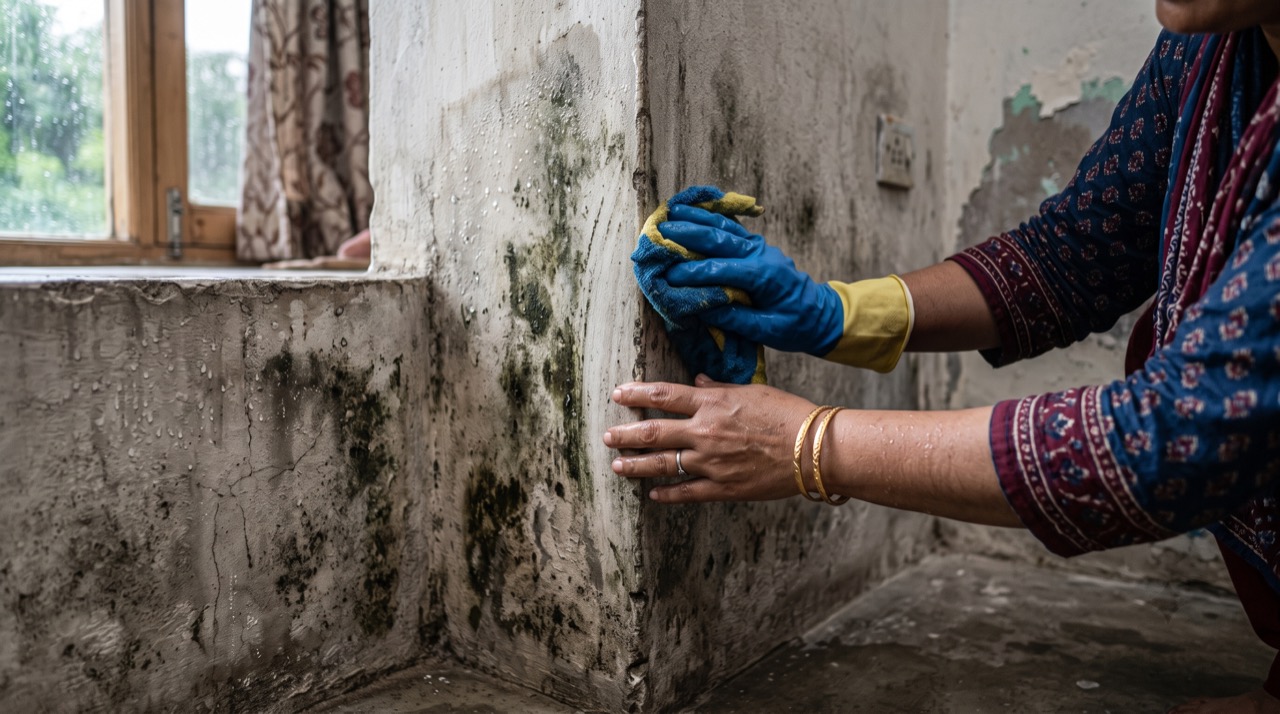
Wiping visible black spots with a dry cloth spreads spores rather than removing them. Use a proper kill-and-clean method instead.
- Mix one part white vinegar with one part water, or use a diluted bleach solution (roughly 1 cup bleach to 4 litres water) for painted walls and tiled bathroom surfaces — never mix bleach with other cleaning chemicals, as the combination can produce dangerous fumes.
- Spray the solution directly on mold patches, let it sit for 10-15 minutes, then scrub with an old toothbrush or stiff-bristled brush before wiping clean with a dry cloth.
- Wear a mask and gloves while cleaning larger mold patches — inhaling disturbed spores is the main way mold triggers coughing and allergic reactions.
- For wooden furniture and almirahs, wipe with a cloth dampened in vinegar solution rather than soaking wood, then dry immediately with a separate dry cloth.
- Check under sinks, behind curtains, and inside shoe cupboards weekly during peak monsoon — these low-airflow spots are where mold establishes first and is easiest to catch early.
- If a wall keeps growing mold in the same spot every year despite cleaning, it usually signals a deeper leak or rising damp from outside — that needs a mason or waterproofing specialist rather than repeated surface cleaning.
A damp wall you dry today is far cheaper to fix than the peeling plaster and mold-stained paint you'll be dealing with by October.
Protecting Health and Long-Term Structure
- Store important documents, books, and leather items in sealed plastic containers with a silica packet rather than open shelving during peak monsoon months.
- Check exterior wall cracks and roof drainage before the season starts each year — water finds the smallest gap and works inward over weeks, so a five-minute inspection in May saves a lot of cleanup in August.
- If anyone in the house has asthma or dust allergies, keep their room the highest priority for daily airing and dehumidifying, since indoor mold exposure is a well-documented asthma trigger according to health bodies like the World Health Organization.
- Repaint with a moisture-resistant or anti-fungal exterior paint after the monsoon ends — it's a one-time cost that meaningfully cuts down on next year's mold recurrence on boundary and ground-floor walls.
Roman Urdu
Pakistan mein monsoon ke mausam mein — yani June ke akhir se September tak — ghar ki deewaron, kapdon aur almariyon mein nami (dampness) aur fungus (mold) ka masla aam hai. Yeh sirf dekhne mein buri nahi lagti, balke sehat ke liye bhi khatarnak ho sakti hai — khaas kar bachon aur bado mein allergy ya asthma ka masla badha sakti hai. Lekin thori si mehnat aur roz ki aadaton se is masle se bacha ja sakta hai.
Sab se pehle ventilation theek karein — din mein 15-20 minute ke liye ghar ki khirkiyan dono taraf se khol dein taake hawa cross ho sake. Kitchen aur bathroom ka exhaust fan cooking ya nahane ke baad kam az kam 10 minute chalta rehna chahiye. Almari aur furniture ko deewar se thora hata kar rakhein taake unke peeche hawa guzar sake.
Agar budget ho to dehumidifier istemal karein, warna almari mein namak (rock salt) ya chawal ke katore rakh dein jo nami khinch lete hain — inhe har chand din baad badalte rahein. Gile kapde ghar mein dher na karein, fan ke saamne sukhayein ya thori der ke liye iron kar dein taake nami aur fungus khatam ho jaye.
Mold saaf karne ke liye sirf sukhe kapde se na poinchein — sirka (vinegar) aur pani barabar matra mein mila kar spray karein, 10-15 minute chhod dein, phir purani brush se rgad kar saaf karein. Bleach istemal karte waqt kisi aur cleaning chemical ke saath na milayein, warna nuksan deh gas ban sakti hai. Saaf karte waqt mask aur gloves zaroor pehnein.
Agar ek hi jagah har saal mold wapis aata hai to yeh kisi chhupe hue leakage ya seelan ki nishani hai — is soorat mein mistri ya waterproofing expert se rabta karein. Monsoon shuru hone se pehle chhat aur bahar ki deewaron ki dararein check kar lein, kyunke thori si ehtiyat baad mein bohot sa nuksan aur kharcha bacha sakti hai.