A fall that looks minor can change an elderly person's life overnight. A hip fracture in a 70-year-old parent often means weeks in bed, loss of independence, and for some, complications that never fully resolve. The good news is that most falls are preventable. A few changes to the home, a short daily routine, and attention to bone health can dramatically lower the risk for the buzurgs in your family — whether they live with you in Lahore, Karachi, Faisalabad, or any Pakistani home with its usual mix of stairs, wet bathroom floors, and loose electrical wires.
Make the Home Genuinely Fall-Proof
Most falls in elderly people happen inside the house, not outside it. Walk through the home with fresh eyes and fix these common hazards:
- Bathrooms: Fit a rubber mat or anti-slip strips in the wash area, install a sturdy handrail near the toilet and shower, and keep a plastic stool for bathing so your elder doesn't stand on a wet, soapy floor.
- Lighting: Add a night light in the hallway and near the bed. Many falls happen at 2 or 3 a.m. on the way to the washroom in the dark.
- Floors and rugs: Remove loose prayer mats, rugs with curling edges, or anything that can slide underfoot. Tape down electrical wires and phone chargers instead of leaving them across walking paths.
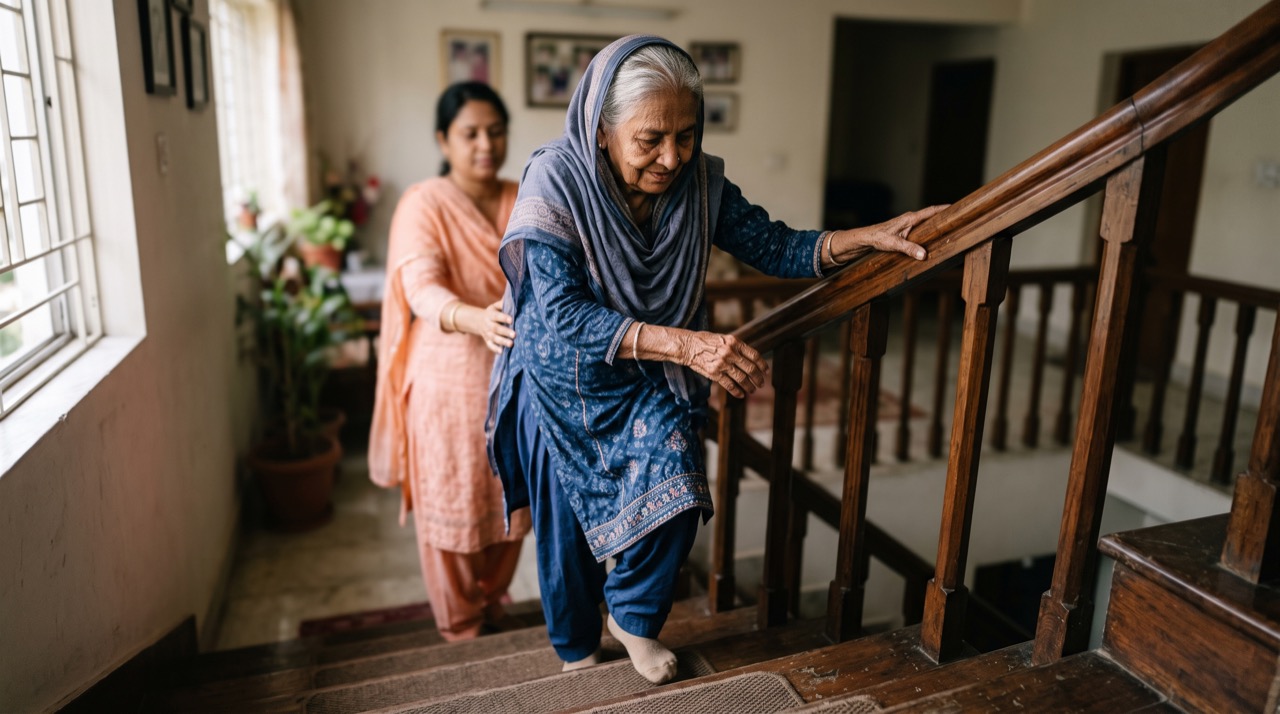
- Stairs: Fix broken steps, add a second handrail if only one exists, and mark the edge of each step with bright tape if your parent's eyesight is weak.
- Footwear: Replace loose chappals with closed-back, non-slip shoes for walking around the house. Slippery socks on marble or tile floors are a common, underrated cause of falls.
- Furniture height: Chairs and the bed should be at a height where your elder can sit and stand without collapsing into them or straining to get up. A firm cushion can raise a low sofa.
Balance and Strength: A Short Daily Routine
Muscle weakness and poor balance are the two biggest contributors to falls after age 65. The muscles that keep us upright weaken quietly over years unless they are used. A short daily routine — 10 to 15 minutes — makes a real difference within weeks.
- Sit-to-stand: Standing up from a chair without using the hands, 8-10 times, builds leg strength needed to recover balance quickly.
- Heel-to-toe walking: Walking in a straight line placing one foot directly in front of the other, near a wall for support, trains balance reflexes.
- Standing on one leg: Holding the back of a chair, standing on one leg for 10-15 seconds, then switching — this is one of the simplest tests and trainers of balance.
- Daily walking: A 20-30 minute walk, even slow and indoors, keeps leg strength and coordination active. If weather or air quality outside is poor, walking laps of a veranda or hallway works fine.
- Vision and hearing checks: Get eyesight tested yearly after 60. Cataracts and outdated glasses prescriptions are a hidden cause of missed steps and misjudged distances.
Bone Health: Calcium, Vitamin D, and Medical Checks
Even a small fall can fracture a bone weakened by osteoporosis, which is extremely common in older Pakistani women especially after menopause, partly due to low dairy intake and limited sun exposure once women spend most of the day indoors or fully covered.
- Calcium-rich diet: Milk, dahi, paneer, sesame seeds (til), and leafy greens like saag should be part of the daily diet. According to the NIH Office of Dietary Supplements, adults over 50 generally need 1,000-1,200 mg of calcium daily for bone strength.
- Vitamin D from sunlight: Despite Pakistan's sunny climate, vitamin D deficiency is widespread because of limited direct skin exposure. A short 15-20 minute walk in morning sunlight, with arms and face exposed, helps the body produce vitamin D naturally.
- Bone density check: Ask a doctor about a DEXA scan for anyone over 60, especially women, particularly if there is a family history of fractures or a hunched posture developing.
- Medication review: Some blood pressure or sleep medicines cause dizziness. Ask the doctor to review all medicines together at least once a year, since dizziness from drug interactions is a frequently missed fall cause.
A grab bar costs less than a single day's hospital stay — but it's usually only installed after the fall, not before.
Falls are not a normal, unavoidable part of getting old — they are usually the result of specific, fixable risks. Spend one weekend walking through your parents' or grandparents' home with this list, start the daily balance exercises together, and bring bone health into your next family doctor visit. It's a small investment of time that protects years of their independence.
Roman Urdu
Ghar ke buzurgon ka girna aksar bohat khatarnak sabit hota hai — ek choti si girawat bhi hip fracture ki wajah ban sakti hai jo hafton ka bistar aur azadi ka nuqsan la sakti hai. Lekin zyada tar falls ko rokna mumkin hai, agar ghar mein chand tabdeeliyan ki jayen aur roz ki halki exercise ki jaye.
Ghar Ko Mehfooz Banayein
Bathroom mein rubber mat aur handrail lagayein takay geeli farsh par phisalne ka khatra kam ho. Raat ke waqt corridor aur bedroom ke qareeb night light rakhein kyun ke aksar falls raat ko washroom jaate waqt hoti hain. Dhile qaleen ya prayer mat hata dein, wires ko tape se chipka dein, aur seerhiyon ke edges par bright tape lagayein agar nazar kamzor ho. Chappal ki jagah band, non-slip joote pehnayein — marble ya tile farsh par slippery socks bhi girne ki aam wajah hai.
Balance Aur Taqat Ki Rozana Mashq
Umar ke sath tang aur balance kamzor hota hai, lekin thodi c rozana mashq se yeh wapas behtar ho sakta hai. Kursi se bagair haathon ke uthna-baithna, deewar ke sahare ek line mein chalna, aur kursi pakar kar ek tang par khare hona — yeh sab exercises sirf 10-15 minute mein ho jati hain aur balance mazboot karti hain. Roz 20-30 minute ki halki walk bhi tang ki taqat barqarar rakhti hai. Har saal aankhon ka check-up bhi zaroori hai kyun ke dhundli nazar se qadam ghalat par sakta hai.
Haddiyon Ki Sehat
Osteoporosis, yani haddiyon ka kamzor hona, Pakistani khawateen mein khaas taur par menopause ke baad bohat aam hai. Doodh, dahi, paneer, til, aur saag jaisi cheezein calcium ke liye rozana khane mein shamil karein — NIH ke mutabiq 50 saal se upar afraad ko rozana 1000-1200 mg calcium chahiye. Subah ki dhoop mein 15-20 minute baithna vitamin D ke liye faydemand hai. 60 saal se upar afraad, khaas taur par khawateen, ko doctor se bone density test ke bare mein zaroor poochna chahiye, aur saal mein ek baar tamam dawaiyon ka jaiza bhi lena chahiye kyun ke kuch dawaiyan chakkar ki wajah ban sakti hain.
Ek handrail ya grab bar ki qeemat hospital ke ek din ke kharche se bhi kam hai — lekin aksar yeh fall hone ke baad hi lagaya jata hai, pehle nahi. Is weekend apne ghar ka jaiza lein, buzurgon ke sath exercise shuru karein, aur agli doctor visit mein bone health par baat zaroor karein.