Hearing "your glucose tolerance test came back positive" can feel frightening, especially in the middle of an already overwhelming pregnancy. But gestational diabetes (GDM) is one of the most manageable pregnancy complications there is. With the right diet, regular monitoring, and a bit of daily discipline, the overwhelming majority of women with GDM go on to have healthy pregnancies and healthy babies. This guide walks through what actually works, in plain language, for expecting mothers in Pakistan who have just received this diagnosis.
Understanding What Just Happened to Your Body
Gestational diabetes develops when pregnancy hormones — mainly from the placenta — make your body's cells more resistant to insulin. Your pancreas has to work harder to keep blood sugar in a normal range, and in some women it simply cannot keep up. This usually shows up around the 24th to 28th week, which is why the oral glucose tolerance test (OGTT) is routinely done at that stage. It is not caused by eating too much sugar, and it is not your fault — but it does need active management for the rest of the pregnancy.
- Uncontrolled GDM raises the risk of a large baby (macrosomia), difficult delivery, and C-section.
- It also raises the risk of the baby having low blood sugar right after birth, and of jaundice.
- For you, it slightly raises blood pressure risk and the chance of developing type 2 diabetes later in life — which is why follow-up testing after delivery matters.
- All of these risks drop sharply when blood sugar is kept in target range consistently.
Building a Diet That Actually Controls Blood Sugar
You do not need to eliminate carbohydrates — your baby's brain needs glucose to grow. The goal is steadier, smaller doses of carbs spread through the day instead of large spikes.
- Swap refined for whole grains: Replace white rice and maida roti with brown rice, daliya, or roti made from atta mixed with besan or soy flour — the extra fibre slows sugar absorption.
- Pair carbs with protein and fibre: Never eat roti or rice alone. Add daal, chana, paneer, eggs, chicken, or fish, plus a vegetable, at every meal.
- Eat smaller, more frequent meals: Three moderate meals plus two to three small snacks keeps blood sugar from spiking or crashing. A common pattern is breakfast, mid-morning snack, lunch, evening snack, dinner, and a small bedtime snack with protein.
- Watch fruit portions and timing: Fruit is healthy but still raises sugar. Have one small portion at a time (half a banana, a small bowl of papaya or guava) and avoid mango, grapes, and sweetened fruit juice, or keep portions very small.
- Cut sugary drinks completely: This includes regular Pepsi/Coke, sweetened tea taken frequently, packaged juices, and lassi with added sugar.
- Breakfast is the hardest meal: Insulin resistance is typically highest in the morning, so keep breakfast carb-light — for example, eggs with one small paratha or a vegetable omelette, rather than a large plate of paratha or sheermal.
- Move after eating: A 15-20 minute walk after meals (safe in most pregnancies unless your doctor advises rest) measurably lowers the post-meal sugar spike.
Monitoring: Your Daily Numbers
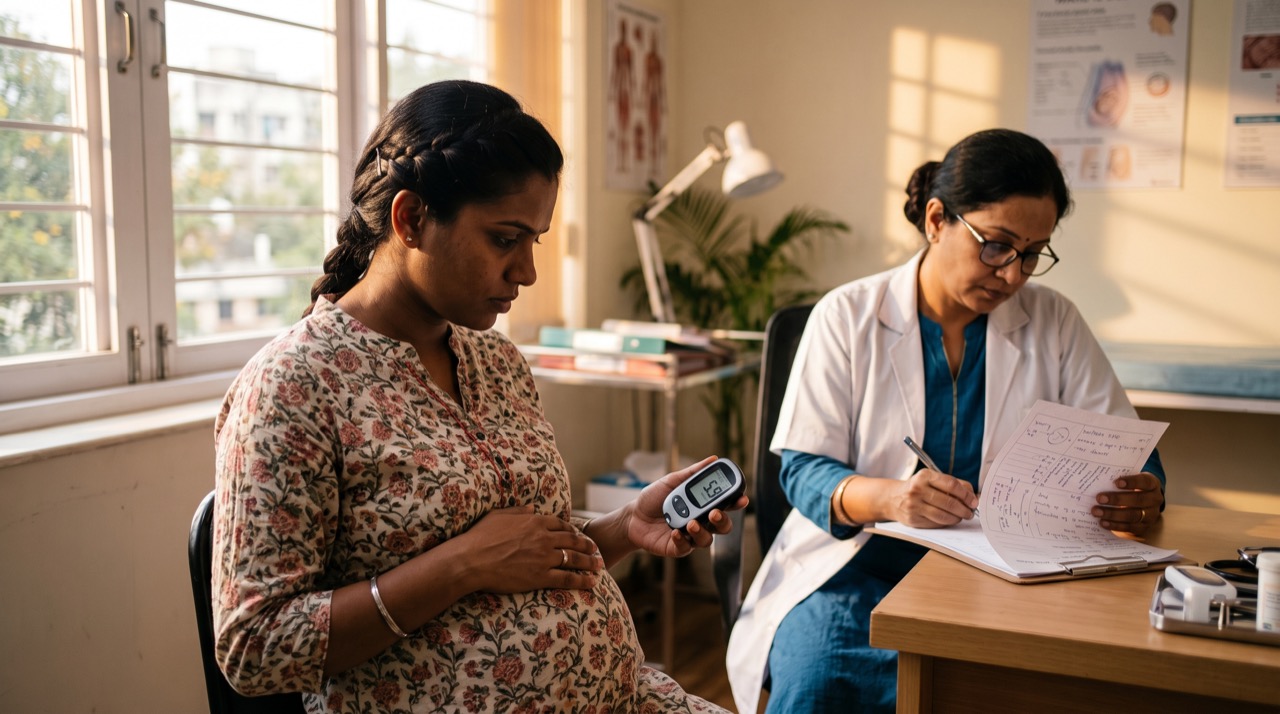
Your doctor will usually ask you to check blood sugar with a home glucometer four times a day: fasting (first thing in the morning) and one or two hours after each main meal. Typical targets recommended by ACOG and the WHO are roughly:
- Fasting: below 95 mg/dL
- 1 hour after meals: below 140 mg/dL
- 2 hours after meals: below 120 mg/dL
Your own doctor's targets may differ slightly — always follow their specific numbers. Keep a simple logbook or a phone note of every reading, meal, and any symptoms; this record is what your obstetrician uses to decide whether diet alone is enough or whether medication or insulin is needed.
Needing insulin does not mean you have failed at managing your diabetes — it simply means your pancreas needs backup help for these few months, and insulin is completely safe for the baby.
Roughly 10-20% of women with GDM eventually need medication or insulin despite good diet control, and that is completely normal — it is about the placenta's hormone load, not about willpower.
Working With Your Healthcare Team
- Attend every scheduled antenatal visit — growth scans become more frequent to track the baby's size.
- Ask specifically for a referral to a nutritionist or dietitian if your hospital offers one; a meal plan tailored to your weight, activity, and food preferences works far better than generic advice.
- Get your blood pressure checked at every visit, since GDM slightly raises preeclampsia risk.
- Plan for a follow-up glucose test 6-12 weeks after delivery — GDM usually resolves after birth, but it needs confirming.
- If breastfeeding, know that it actually helps regulate your blood sugar and is strongly encouraged.
Roman Urdu
Agar aap ka glucose test positive aaya hai to ghabrayen nahi — gestational diabetes (GDM) aksar sirf diet aur monitoring se hi control ho jati hai. Ye pregnancy hormones ki wajah se hota hai jo insulin ka asar kam kar dete hain, aur ye aap ki ghalti nahi hai.
Diet mein sabse zaroori baat ye hai ke carbs ko protein aur fibre ke sath khayen — sirf roti ya chawal akele na khayen, daal, anda, chicken ya paneer sath mein zaroor lein. Safed chawal aur maida ki jagah brown rice, daliya, ya besan-mila atta istemal karen. Khana thora thora par baar baar khayen — teen bara khana aur do teen halki snacks, taake sugar achanak na barhe. Subah ka nashta halka rakhen kyunke is waqt insulin resistance sab se zyada hota hai. Phal khayen lekin thori quantity mein — mango aur angoor se parhez karen, aur meethay drinks (Pepsi, packaged juice) bilkul chor den. Khane ke baad 15-20 minute walk karna sugar ko kaafi kam kar deta hai.
Monitoring ke liye glucometer se din mein 4 martaba sugar check karen — fasting aur har khane ke 1-2 ghante baad. Doctor ke diye hue target numbers ko follow karen aur har reading ko note karte rahen, taake doctor decide kar sakein ke sirf diet kaafi hai ya insulin ki zaroorat hai. Agar insulin lena pare to ye kisi failure ki nishani nahi — bohat si khawateen ko lena parta hai aur ye baby ke liye bilkul safe hai.
Har antenatal visit zaroor attend karen, blood pressure check karwate rahen, aur delivery ke 6-12 hafte baad follow-up sugar test zaroor karwayen kyunke GDM aksar baby hone ke baad khud theek ho jata hai. Breastfeeding bhi aap ke sugar ko control karne mein madad karti hai. Sahi diet, regular monitoring, aur doctor se mustaqil rabta rakhne se aap aur aap ka baby dono healthy reh sakte hain.