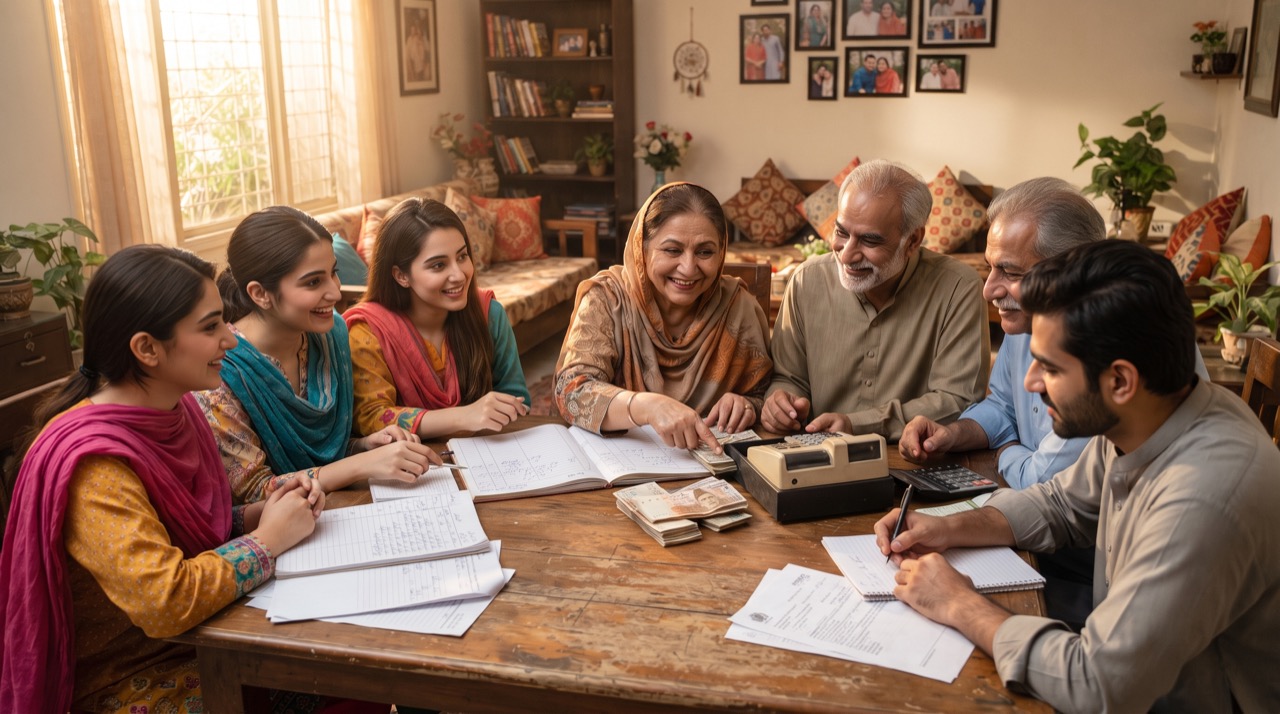
Long before anyone in Pakistan had a bank app, families and neighbourhoods had a simpler tool for reaching big financial goals: the committee, also called BC (Beesi) or ROSCA (Rotating Savings and Credit Association). A group of trusted people each contribute a fixed amount every month, and one member takes the full pot on a rotating basis until everyone has had a turn. No interest, no paperwork, just a shared commitment. Used carefully, a committee can help you fund a wedding, a small business, a child's tuition, or a down payment on a motorcycle or shop — without ever touching a credit card. Used carelessly, it can wipe out months of hard-earned savings. Here is how to make the system work for you instead of against you.
How a Savings Committee Actually Works
The mechanics are simple, but the details matter more than most people realise before joining one.
- Fixed contribution: Every member pays the same amount on the same date each month (for example, Rs. 10,000 x 12 members = Rs. 120,000 pot).
- Rotation order: The order in which members receive the pot is usually decided by draw (qurah), by need, or by seniority/trust within the group.
- Duration: A 12-member committee at monthly intervals runs for a full year — know the total commitment length before you join, not just the monthly amount.
- An organiser (manager): Someone collects the money and hands over the pot each round. This person's reliability is the single biggest factor in whether the committee survives.
- No interest, but no guarantee either: Because it isn't a bank product, there is no regulator, no insurance, and no legal recourse if someone defaults or the organiser disappears with the funds — this is the trade-off for the zero-interest structure.
The Real Pros
- Forced discipline: A monthly obligation to the group is often more effective than a personal savings goal, because social pressure keeps you consistent.
- Lump-sum access without debt: If you draw an early turn, you effectively get an interest-free advance — useful for time-sensitive costs like school admissions or a wedding date.
- Community trust-building: Committees are often run among relatives, coworkers, or mohalla neighbours, reinforcing mutual accountability.
- Zero fees, zero riba: For those who want to avoid interest-based products entirely, a well-run committee is one of the cleanest tools available.
The Real Pitfalls
- Default risk: If a member takes their turn early and then stops paying, everyone after them absorbs the loss. This is the most common way committees collapse.
- No legal protection: Unlike a bank deposit, there's no institution backing a committee. Disputes are settled socially, not legally, which rarely favours the person who lost money.
- Opportunity cost: Money sitting in a committee earns nothing, and if you draw a late turn, you've effectively lent your savings interest-free for months.
- Pressure to overcommit: It's easy to join two or three committees to "grow faster," only to find the combined monthly outflow exceeds what your income can safely support.
How to Join One Responsibly
- Only join with people you already trust deeply — ideally people whose income stability you can reasonably judge, not casual acquaintances.
- Write it down. Even an informal WhatsApp group record of who pays what, when, and who has already received their turn removes ambiguity and reduces disputes later.
- Choose your turn deliberately. If you have a near-term goal (a deposit, tuition deadline), aim for an earlier slot. If you're simply building a saving habit, a later slot works fine.
- Never contribute more than you could afford to lose. Treat committee contributions like any other risk: size them to what wouldn't hurt your household if a member defaulted.
- Keep the group small and consistent. Six to twelve members is easier to manage and monitor than a large, loosely connected group.
- Pair it with a real financial goal. Decide in advance exactly what your payout will fund, so the money doesn't get absorbed into daily spending the moment it arrives.
A committee is only as strong as the weakest member's commitment — choose your circle as carefully as you choose your goal.
Committees Alongside Formal Savings Tools
Committees don't have to replace formal saving — they work well alongside it. Pakistani banks and Islamic banks offer Shariah-compliant term deposit and mudarabah-based savings accounts that, unlike committees, are regulated by the State Bank of Pakistan. A practical approach many families use: run a modest committee for short-term, purpose-driven goals (a specific expense within the year), while keeping longer-term savings in a bank or Islamic savings product where funds are protected and can still grow. If you're formalising a small business idea funded by a committee payout, it's also worth checking basic registration guidance from the Securities and Exchange Commission of Pakistan before you scale beyond an informal venture.
Roman Urdu
Committee ya BC (Beesi) Pakistan mein saving ka ek purana aur mazboot tareeqa hai — group ke sab members har mahina fix amount jama karte hain, aur baari baari ek member ko poori raqam mil jaati hai. Na koi interest, na kagazi karwai — sirf aapas ka bharosa. Agar sahi tareeqe se chalayi jaye to committee wedding, business, bachon ki fees, ya ghar ke liye down payment jaisi badi zarooraton ke liye bohat kaam aati hai.
Committee kaise kaam karti hai: Har member ek fix raqam, ek fix date par jama karta hai. Baari qurah (lucky draw) se ya zaroorat ke hisaab se tay hoti hai. Ek organiser (manager) paisay collect karta hai aur har mahina winner ko deta hai — is insaan ki emandari hi committee ki jaan hai.
Fayde: Committee aapko saving ki disciplin sikhati hai, kyunke group ke saamne commitment todna mushkil hota hai. Agar aapki baari jaldi aa jaye to bina interest ke ek lump-sum mil jaata hai — jo emergency ya time-bound kharch (jaise admission ya shaadi) ke liye kaafi madadgar hai. Riba se bachne walon ke liye bhi ye ek saaf tareeqa hai.
Nuqsanat: Sabse bara risk default ka hai — agar koi member apni baari le kar paisay dena band kar de, to baqi sab logon ka nuqsan hota hai. Committee ka koi legal ya bank jaisa tahaffuz nahi hota, is liye jhagray aksar aapas mein hi suljhaye jaate hain. Agar aapki baari late aaye to aapke paisay mahinon tak bina kisi faide ke padey rehte hain.
Samajhdari se committee join karne ke tareeqe: Sirf unhi logon ke saath committee banayein jin par aapko pura bharosa ho. Hisaab likhit shakl mein rakhein (WhatsApp group mein bhi chalega) taake baad mein confusion na ho. Apni zaroorat ke hisaab se baari chunein. Itni hi raqam contribute karein jitni agar koi default kare to aap bardasht kar sakein. Group ko chota aur qareebi rakhein — chhay se barah members behtar hote hain. Aur sab se zaroori: payout milte hi tay karein ke ye kis maqsad ke liye istemal hoga, taake raqam roz mara ke kharchon mein na ghul jaye.
Committee ko formal saving ke saath mila kar bhi istemal kiya ja sakta hai — chhote, waqt-mehdood maqsad ke liye committee, aur lambi mudat ki bachat ke liye State Bank of Pakistan se regulated Islamic bank account. Ye tareeqa dono duniyaon ka faida deta hai — committee ki disciplin aur bank ki hifazat.