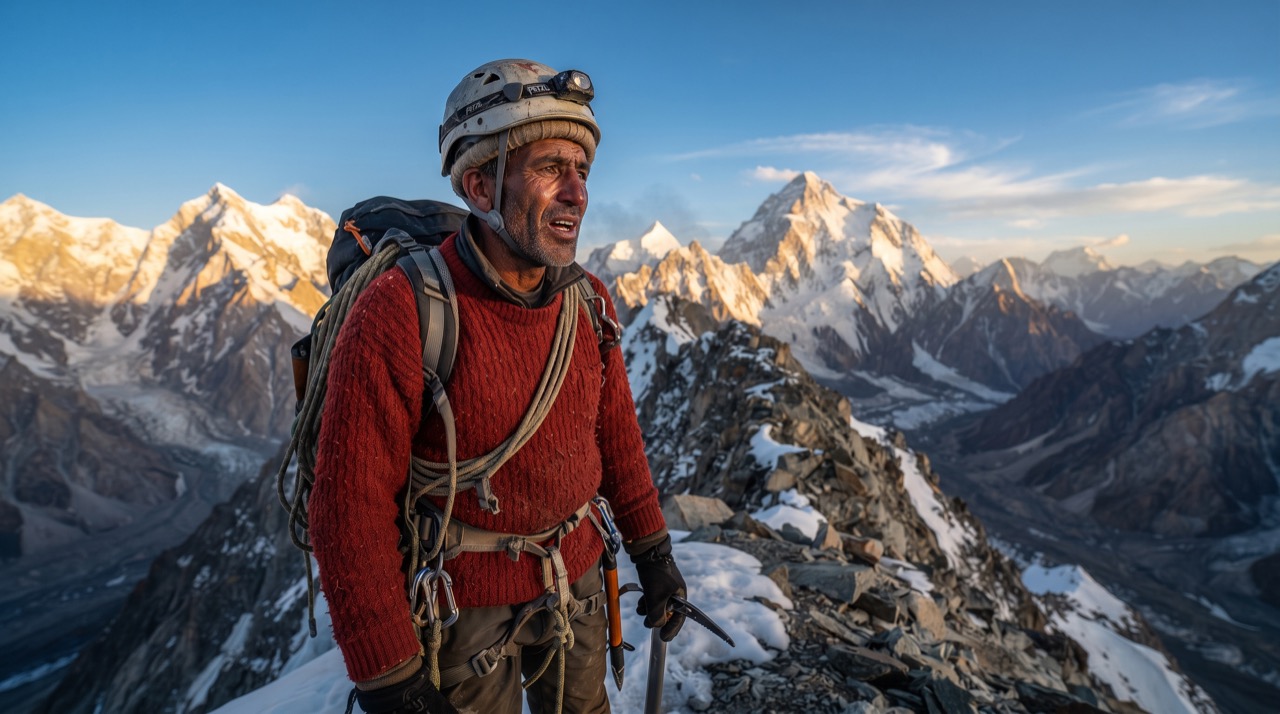
Pakistan is home to five of the world's fourteen "eight-thousanders" — peaks above 8,000 metres, including K2, the second-highest and arguably the most dangerous mountain on Earth. Out of this brutal, beautiful terrain has come a generation of climbers who did not just survive the mountains, they mastered them. Nazir Sabir, the first Pakistani to summit K2 and the first Pakistani to reach the top of Mount Everest, is the name most people know. But he is one of many — alongside more recent stars like Sirbaz Khan, who has summited multiple 8,000-metre peaks, and Samina Baig, the first Pakistani woman to climb Everest. None of them got there by accident. Their approach to an impossible-looking goal has a lot to teach the rest of us, whether our "summit" is a career change, a degree, a business, or simply becoming a more disciplined version of ourselves.
Break the Mountain Into Camps
No climber looks at K2's summit from base camp and tries to walk straight there. Expeditions are broken into a series of camps — Camp 1, Camp 2, Camp 3, and so on — each one a realistic, achievable target before the next push. This is the single most practical lesson for everyday goals:
- Write down the final goal, then work backwards into 4-6 smaller "camps" with their own deadlines.
- Celebrate reaching each camp instead of only the summit — it keeps motivation alive over months, not just days.
- If a camp takes longer than planned, adjust the next one rather than abandoning the whole route.
A student aiming for a competitive exam, a young professional building a business, or someone saving for a house in Lahore or Karachi can use the exact same structure — clear, sequential camps instead of one intimidating leap.
Patience Beats Speed
Climbers talk constantly about "weather windows" — the narrow, unpredictable stretch of good conditions that makes a summit push possible. Sabir and his peers have spent days, sometimes weeks, waiting in a tent for the mountain to allow them forward. Rushing a summit attempt in bad weather is one of the most common causes of death in the Karakoram and Himalaya. The lesson translates directly to ordinary ambition: timing and preparation matter more than raw urgency. Chasing a goal before you're ready, or before circumstances allow it, often costs more than waiting does.
Turning Back Is Not Failure
Perhaps the most underrated trait among elite mountaineers is knowing when to turn around. Everest and K2 are littered with cautionary stories of climbers who pushed on past their turnaround time and never came back. The mountaineers who summit again and again are the ones who have also retreated again and again — living to try another season. In daily life, this means:
- Recognising when a plan, a job, or a relationship is not working and adjusting course without treating it as personal defeat.
- Setting your own "turnaround time" in advance for risky decisions — a budget limit, a deadline, a health warning sign — and respecting it even when you're close to the goal.
- Understanding that a paused goal is not a dead goal; most summits are eventually reached on a second or third attempt.
"The mountain doesn't go anywhere. If it's not your day, you come back and try when it is." — a sentiment echoed by generations of Pakistani climbers who have lived by exactly this discipline.
Build Your Own Support Team
No 8,000-metre summit happens solo. Behind every successful Pakistani climb are High Altitude Porters, mostly from Shimshal and the northern valleys, whose skill and endurance are the backbone of Pakistani mountaineering's international reputation. Sabir himself has spoken often about how success on the mountain is a shared achievement, not an individual one. Whatever you're climbing towards, identify who your "support team" is — a mentor, family members, a study group, a colleague who keeps you accountable — and lean on them deliberately instead of trying to prove you can do everything alone.
You can read more about Pakistan's mountaineering achievements and the Alpine Club of Pakistan's work supporting local climbers at the Alpine Club of Pakistan.
Roman Urdu
Pakistan duniya ke sab se mushkil paharon ka ghar hai — K2 jaisi chotiyan jahan chalna khud ek bahut bada achievement hai. Nazir Sabir, jo K2 aur Everest dono sar karne wale pehle Pakistani hain, aur unke baad Sirbaz Khan aur Samina Baig jaisi shaksiyat, humein sirf climbing nahi, balki zindagi ke bade goals hasil karne ka tareeqa bhi sikhate hain.
Pehli baat — mountain ko ek hi jump mein cross nahi kiya jata, balki Camp 1, Camp 2, Camp 3 jaise chhote chhote padao banaye jate hain. Aap bhi apne bade goal ko 4 se 6 chhote steps mein baant lein, aur har step complete hone par khushi manayein — sirf akhri manzil ka intezar na karein.
Dusri baat — sabr speed se zyada zaroori hai. Climbers "weather window" ka hafton intezar karte hain, kyunke ghalat waqt par jaldbaazi jaan bhi le sakti hai. Zindagi mein bhi, sahi waqt aur tayyari jaldi se zyada important hoti hai.
Teesri baat — wapas mudna haar nahi hai. Jo climbers baar baar summit karte hain, unhone baar baar wapas aana bhi seekha hota hai. Agar koi plan kaam nahi kar raha, ussay chhorna ya delay karna shikast nahi, balki agli koshish ki tayyari hai. Apne liye pehle se ek "turnaround limit" set karein — chahe wo budget ho, deadline ho, ya health ka koi warning sign — aur usse izzat dein.
Aakhri baat — koi bhi 8000-meter chotti akele sar nahi hoti. High Altitude Porters, jo zyada tar Shimshal aur shumali ilaqon se hote hain, har successful expedition ki asal taqat hain. Aap bhi apni team pehchanein — koi mentor, family member, ya dost jo aapko accountable rakhe — aur akele sab kuch karne ki koshish na karein.
Summit door lag sakta hai, lekin jaisa Pakistan ke climbers ne baar baar sabit kiya hai — sahi planning, sabr, aur sahi logon ke saath, har mushkil chotti hasil ki ja sakti hai.