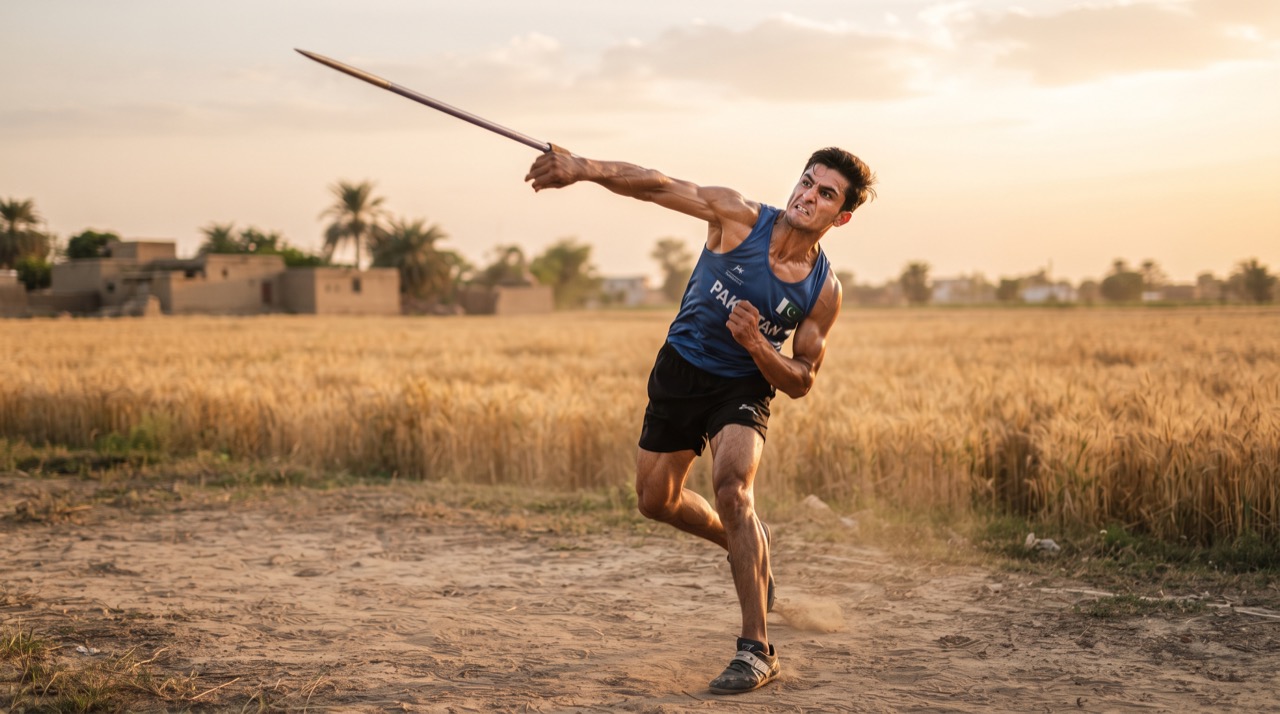
On 8 August 2024, a 27-year-old from a dusty farming town in Punjab sent a javelin arcing 92.97 metres through the Paris night sky — an Olympic record — and delivered Pakistan its first individual Olympic gold medal in history. Arshad Nadeem's journey from Mian Channu, a small town in Khanewal district, to the top of the podium at the Stade de France was not built on luxury academies or years of well-funded coaching. It was built on discipline, patience, and a refusal to let circumstance set the ceiling. For anyone chasing a goal that feels out of reach, his story is a practical blueprint worth studying.
From Mian Channu to the Medal Podium
Arshad grew up in a working-class household; his father worked as a labourer, and the family had little spare income for sports equipment, let alone specialised javelin gear. As a teenager, Arshad was a natural all-round athlete, trying his hand at cricket, shot put and other track and field events before local coaches noticed his throwing arm and steered him toward javelin. He trained on uneven village grounds, often with second-hand or borrowed equipment, long before he ever held a competition-grade javelin in his hands.
His breakthrough came gradually rather than overnight. Youth-level medals were followed by gold at the 2016 South Asian Games, then continued progress through injuries and limited resources. At the 2022 Commonwealth Games in Birmingham, he became Pakistan's first individual gold medallist at that event in six decades. Two years later in Paris, he went from promising contender to Olympic champion and record holder — a result documented in the official results published by the International Olympic Committee.
The Discipline That Built a Champion
What separated Arshad from equally talented juniors was not raw ability alone. It was an unglamorous, repeatable daily discipline that he maintained even when funding, facilities and recognition were scarce. Several habits stand out for anyone trying to build mastery in their own field:
- Consistency over intensity: years of steady technical repetition in footwork, release angle and follow-through built the base — not occasional bursts of hard training.
- Training through setbacks: Nadeem kept competing and training through recurring injuries, including a knee problem that eventually needed surgery, rather than treating a setback as an excuse to quit.
- Using what you have: early in his career he worked with whatever equipment and grounds were locally available instead of waiting for ideal conditions.
- Seeking out competition: he tested himself against stronger international throwers, including his well-known rival Neeraj Chopra of India, which pushed his own technique and mental toughness higher.
Turning Scarcity Into Strength: Lessons for Everyday Life
You do not need to be an Olympic athlete for these principles to apply. A few practical takeaways from Arshad Nadeem's rise:
- Start with what's available — a borrowed book, a free online course, a local mentor — rather than waiting for perfect resources.
- Track small, boring, repeated improvements; mastery is built in unremarkable daily sessions, not occasional bursts of motivation.
- Let community support carry you when personal resources run short, the way Nadeem's hometown and later the Punjab government stepped in with funding and equipment at key moments.
- Treat injuries, failures or slow seasons as part of the process, not proof that you should stop.
Champions are rarely made in stadiums full of cheering crowds — they are made on empty village grounds, in early mornings, through injuries and setbacks nobody else sees.
Arshad Nadeem's gold medal is a single moment, but it rests on more than a decade of unseen work. For young Pakistanis with big dreams and limited resources, his story is proof that discipline, patience and community support can close a gap that money and opportunity alone cannot.
Roman Urdu
8 August 2024 ko Punjab ke chhote se qasbay Mian Channu, Khanewal se taalluq rakhne wale 27 sala Arshad Nadeem ne Paris Olympics mein 92.97 meter ka record throw kar ke Pakistan ko uska pehla individual Olympic gold medal dilaya. Yeh kamyabi kisi mehngi academy ya foreign coaching ka nateeja nahi thi, balke saalon ki mehnat, sabr aur mushkil halaat mein bhi practice jari rakhne ka nateeja thi.
Arshad ek mazdoor ghar mein paida huay; unke walid labour ka kaam karte thay aur ghar mein khel ke saaz-o-saman ke liye zyada paisa nahi hota tha. Woh gaon ke kacche maidano mein, purane ya udhaar liye gaye equipment ke sath practice karte thay. Waqt ke sath unki mehnat rang layi — 2016 South Asian Games mein gold, phir 2022 Commonwealth Games mein Pakistan ka pehla individual gold (chhay dahaiyon baad), aur aakhir kar Paris mein Olympic record ke sath gold medal.
Unki kamyabi ke peechay kuch aadaten hain jo har koi apni zindagi mein apply kar sakta hai:
- Jo resources maujood hain unhi se shuru karo, perfect halaat ka intezar mat karo.
- Roz ki chhoti, boring lagne wali mehnat hi asal mein mastery banati hai, sirf josh ke lamhe nahi.
- Chot ya nakami ko rukawat nahi balke safar ka hissa samjho — Arshad ne ghutne ki surgery ke baad bhi practice jari rakhi.
- Community aur family ka sahara qabool karo — Mian Channu aur Punjab government ne ahem lamhon par unki madad ki.
- Apne se behtar players ke against khelo taake apni kamzori pata chale aur behtar bano.
Arshad Nadeem ki kahani un tamam Pakistani naujawano ke liye misaal hai jo mehdood resources ke bawajood bade khwaab dekhte hain. Nizam, sabr aur mustaqil mehnat se woh faasla poora kiya ja sakta hai jo sirf paise se poora nahi hota.